Add Republic As Your Trusted Source




Add Republic As Your Trusted Source
Advertisement
Updated March 4th 2025, 13:34 IST
Indian Defence Ministry’s Game Plan for Air Dominance, Modernizing IAF for Multi-Domain Warfare
The report highlights a time-bound roadmap to modernize the IAF, emphasizing Aatmanirbharta (self-reliance) and reducing dependency on foreign imports.


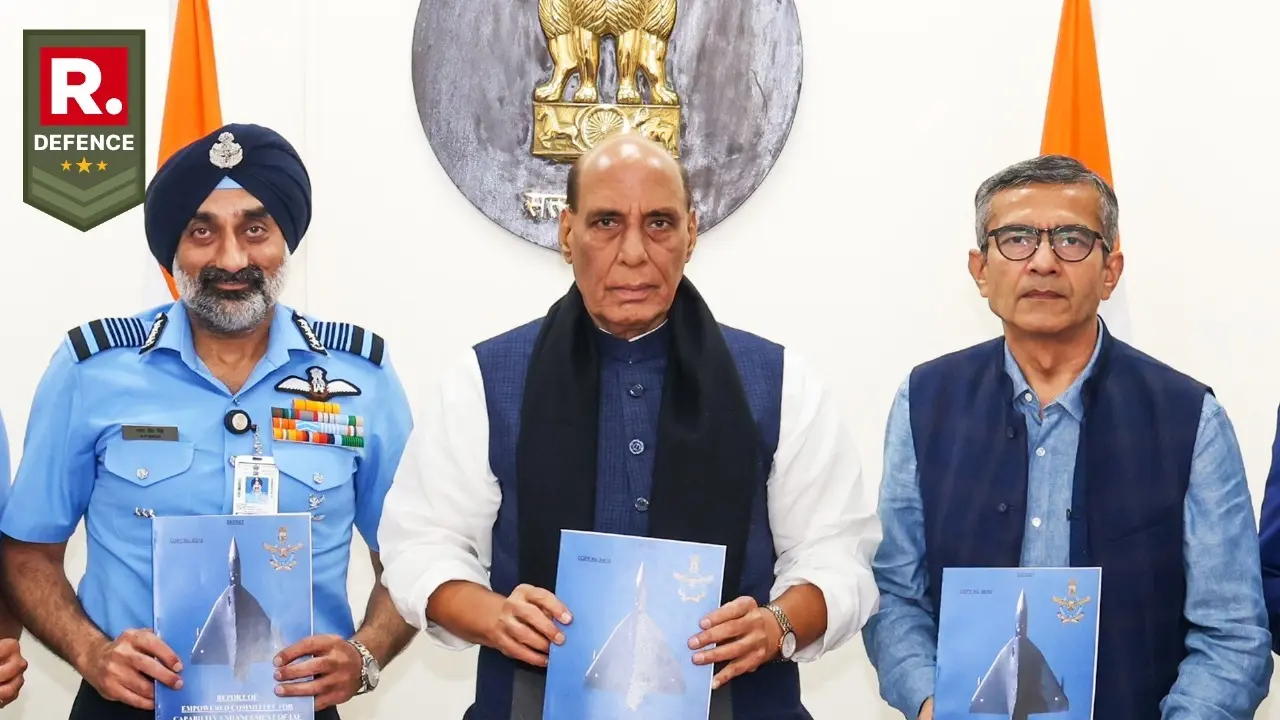
New Delhi, India – In a crucial step towards modernizing the Indian Air Force (IAF), Defence Secretary Rajesh Kumar Singh presented the Empowered Committee’s report on capability enhancement to Defence Minister Rajnath Singh on Monday. The document lays down a detailed roadmap for the IAF’s future—outlining key thrust areas, proposing a structured implementation plan, and underscoring the urgency to adapt to evolving air warfare challenges.
At the heart of the report is a clear message: Aatmanirbharta (self-reliance) in aerospace is non-negotiable. With geopolitical tensions rising and air power becoming increasingly decisive in conflicts, India’s defence planners are keen to cut down on dependence on foreign imports and push for a robust indigenous military-industrial complex. The report advocates greater private sector participation, alongside the Defence Public Sector Undertakings (DPSUs) and the Defence Research and Development Organisation (DRDO), to ensure that the IAF remains agile, lethal, and future-ready.
The Stakes Are High: IAF at a Crossroads
The timing of this report is significant. Just last week, the IAF unveiled a fresh Doctrine 2024, outlining how it views air power in modern warfare. The doctrine emphasized the need for multi-domain operations, seamless integration of cyber, space, and electronic warfare, and a sharper focus on indigenous capabilities. This capability enhancement report now adds another layer—translating the doctrine into actionable steps.

Formed on Rajnath Singh’s directive, the Empowered Committee had a clear task: "Identify gaps, chart a plan, and ensure that the IAF is ready for future conflicts."
The committee, chaired by the Defence Secretary, included some of the most senior officials in India’s defence establishment:
- Vice Chief of Air Staff
- Secretary (Defence Production)
- Secretary, Department of Defence R&D and Chairman DRDO
- Director General (DG) Acquisition
- Deputy Chief of the Air Staff (Member Secretary)
The recommendations presented to the Defence Minister cover three timeframes: short-term, medium-term, and long-term, ensuring a phased but relentless modernization push.
Filling the Gaps: What Needs to Change?
The report makes no secret of the challenges the IAF faces. For years, the Air Force has struggled with delays in procurement, an ageing fleet, and a fighter squadron shortage. With China ramping up its air power and Pakistan actively modernizing its force with Chinese-made J-10C fighters and Turkish drones, the IAF has no room for complacency.
Among the key takeaways from the report:
- Accelerate Indigenous Production: The report strongly pushes for fast-tracking the development of next-generation fighter jets, including the Tejas Mark 2 and Advanced Medium Combat Aircraft (AMCA), to ensure the IAF’s fighter strength doesn’t dip below critical levels.
- Boost the Private Sector’s Role: While DPSUs like Hindustan Aeronautics Limited (HAL) have traditionally led military aviation projects, the report suggests that private players must step in to drive efficiency, innovation, and speed.
- Missile & UAV Modernization: Acknowledging the growing role of long-range strike capabilities, the committee stresses ramping up indigenous missile production, including the Astra air-to-air missile and long-range cruise missiles. Additionally, it calls for an accelerated push for combat drones and autonomous swarm technologies.
- Multi-Domain Integration: The IAF is expected to become more network-centric, integrating satellites, cyber warfare tools, and electronic countermeasures to dominate across multiple domains. This echoes the new doctrine’s push for "sensor fusion" and AI-based battle management systems.
“Follow Up in a Time-Bound Manner” – Rajnath Singh’s Directive
After reviewing the report, Defence Minister Rajnath Singh instructed that the recommendations be pursued aggressively. “This is not just about modernizing the Air Force; this is about making sure India remains ahead in the game,” a senior defence official said. “We are not looking at small, incremental changes. We need a paradigm shift.”
Singh’s insistence on a time-bound approach is crucial. Past modernization efforts have been mired in delays, often due to bureaucratic red tape, budget constraints, or shifting priorities. This time, the government appears determined to fast-track approvals and ensure quick implementation.
Beyond Fighter Jets: A Holistic Push for the Air Force
While much of the focus remains on fighter jet acquisition, the report also calls for improving airlift capabilities, enhancing surveillance, and expanding aerial refuelling operations. Additionally, it suggests that India’s Air Defence Network be upgraded to counter hypersonic threats, a domain where both China and the U.S. are making rapid advancements.
The IAF has already begun deploying S-400 missile defence systems, but the report indicates that domestically developed systems, such as the DRDO-led XRSAM (Extended Range Surface-to-Air Missile), must be pushed into service at the earliest.
CSR Push for Armed Forces Welfare
On the same day, Rajnath Singh also addressed the Armed Forces Flag Day Corporate Social Responsibility (AFFD CSR) Conclave in New Delhi, calling on citizens to support soldiers and their families.
Singh reiterated that while the government is fully committed to strengthening national security, civil society must also step up.
“CSR is not just a 2% corporate obligation. It is about a genuine commitment to our armed forces and their dependents,” Singh said.
The IAF’s modernization drive is no longer just an option—it is an urgent necessity. The Empowered Committee’s report, combined with the IAF Doctrine 2024, provides a comprehensive vision for the Air Force's transformation.
However, vision without execution is meaningless. The real test will be how quickly the recommendations are implemented. For now, one thing is clear: The IAF is gearing up for a major leap forward, and the coming years will define whether India can truly become an aerospace powerhouse.
Published March 4th 2025, 13:32 IST