Add Republic As Your Trusted Source




Add Republic As Your Trusted Source
Advertisement
Updated July 7th 2025, 19:53 IST
A New War in the Caucasus? The Nakhchivan Corridor Crisis and India’s Emerging Role
Together, India, Armenia, Greece, and Cyprus are laying the groundwork for what feels like an “Indian Mediterranean Quad.” While still informal, this alignment is rooted in shared democratic values, opposition to Turkish and Pakistani revisionism, and mutual economic-security interests.


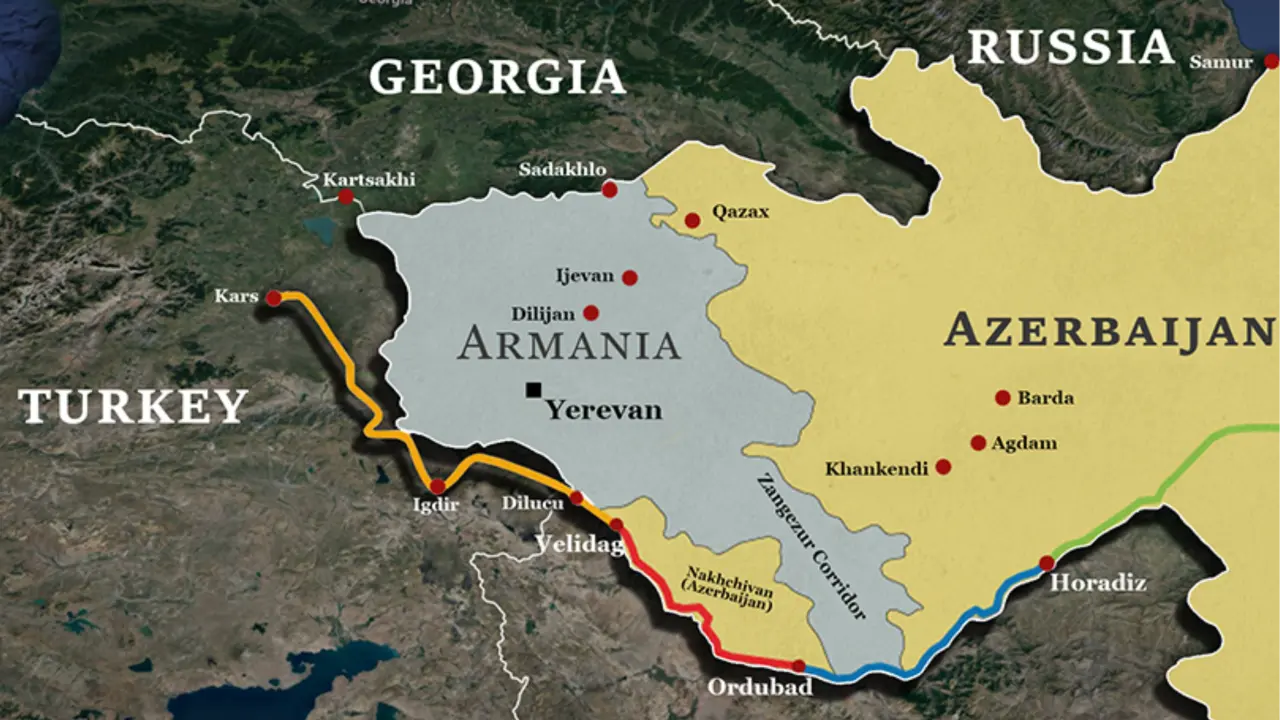
In September 2023, Azerbaijan’s lightning offensive in Nagorno-Karabakh shattered the uneasy status quo, forcing nearly 100,000 ethnic Armenians, virtually the entire population of the breakaway region – to flee into Armenia within days. The rapid military victory emboldened Azerbaijan to pursue broader ambitions: a land corridor through southern Armenia’s Syunik province to connect its mainland to the Nakhchivan exclave, separated since Soviet times.
The Nakhchivan Corridor Crisis and India’s Emerging Role
This so-called “Zangezur Corridor” has become the next flashpoint. Backed strongly by Turkey, Azerbaijan frames it as a transit link critical for pan-Turkic connectivity and trade. Turkey has called it a vital step towards uniting Turkic nations “from Anatolia to Central Asia,” while Azerbaijan insists it is part of the peace terms that ended the 2020 and 2023 Karabakh wars. Turkey’s top leaders describe the corridor as the “final step” in normalizing relations with Armenia.
Armenia, however, views this as an existential threat to sovereignty. Government advisers warn that any corridor under foreign or international control would effectively split the country in two. In recent months, Armenian forces have mobilized along Syunik’s borders to deter what they see as creeping annexation by Azerbaijan.
The Neighbors Reaction: Iran and Russia
The regional reactions have been stark. Iran, which shares a short but strategic border with Armenia south of Syunik, has issued blunt warnings. Iran’s foreign ministry has declared it is “against any geopolitical changes” altering internationally recognized borders, and the Iranian Supreme Leader has personally told Armenia that a Zangezur corridor would be “detrimental” to regional stability. Tehran fears it would sever its own land route to Armenia and expand Turkish and Israeli influence along its northern frontier.
Russia’s position is more ambiguous. While officially framing the corridor debate as “unblocking regional communications,” Russia’s foreign minister in 2024 signaled quiet approval for Azerbaijan’s plan, which drew immediate criticism from Iran. However, Russia remains Armenia’s primary security guarantor under the CSTO treaty, maintaining a peacekeeping force and military bases in the country. Armenia, therefore, finds itself caught between defending sovereignty and retaining Russian protection.
Pakistan, Turkey and Azerbaijan: An Emerging Axis
The corridor crisis is inseparable from the deepening alliances shaping the Caucasus. During the Karabakh conflicts, Israel emerged as Azerbaijan’s largest arms supplier, providing drones, loitering munitions, air defence radars, and advanced electronic warfare systems. Israeli drones in particular proved decisive in neutralizing Armenian positions. This defence trade has continued post-2023, with Azerbaijan openly praising Israel’s technological support.
Meanwhile, Turkey and Pakistan have become Azerbaijan’s most vocal political and military backers. Turkey supplied Bayraktar drones, special forces trainers, and battlefield intelligence during the Karabakh war. Pakistan has pledged logistic and special forces support to Azerbaijan under the framework of the “Three Brothers” strategic alliance.
This tripartite partnership has been formalised through:
- The 2021 Baku Declaration, pledging mutual backing on territorial disputes including Nagorno-Karabakh and Kashmir.
- Regular “Three Brothers” military exercises, featuring special forces, UAV operations, and interoperability drills since 2021.
- Joint production agreements between Turkey and Pakistan for drones, small arms, and munitions, further binding their defence industries.
Together, this Turkey–Pakistan–Azerbaijan axis presents a consolidated front in the Caucasus and South Asia, projecting unified military and diplomatic leverage.
Armenia, Greece and Cyprus: Building a Counterbalance
In response, Armenia has deepened its trilateral defence partnership with Greece and Cyprus. Since 2021, the three nations have held annual meetings and exercises under a formal cooperation programme. In December 2024, they renewed their Trilateral Defence Cooperation Program for 2025, focusing on joint training, mountain warfare, special forces exchanges, and counter-drone tactics.
For Greece and Cyprus, supporting Armenia also serves their own strategic interests in deterring Turkish assertiveness in the Eastern Mediterranean. For Armenia, it brings European partners into its security orbit, diversifying beyond Russia.
India’s Quiet but Strategic Entry
Amid these shifting alliances, India has emerged as Armenia’s largest defence supplier. Since 2022, New Delhi has signed contracts worth over $600 million, supplying:
- Pinaka multi-barrel rocket launchers
- Akash and Akash-NG air defence systems
- Swathi weapon-locating radars
- Advanced towed artillery guns (ATAGS)
- Anti-drone systems
For India, these exports are not mere commerce but strategic signalling to Turkey and Pakistan, both of whom back Azerbaijan and remain adversaries on the Kashmir issue.
India has also expanded ties with Greece:
- Prime Minister Modi visited Greece in August 2024, the first such visit in four decades.
- The Indian Navy Chief visited Greece in September 2024, discussing naval cooperation.
- In December 2024, the Indian DIA Chief visited Greece, deepening intelligence-sharing mechanisms.
- The Indian Air Force participated in INIOCHOS-25 exercises in April 2025, integrating with NATO-standard air combat operations.
- The Chief of the Indian Air Force Visited his counterpart in Greece in June 2025
Simultaneously, India has renewed ties with Cyprus:
- Prime Minister Modi visited Cyprus in June 2025, signing a Comprehensive Partnership Agreement.
- Defence cooperation, naval port calls, and joint energy exploration were prioritised, with Cyprus offering a potential gateway to Eastern Mediterranean oil and gas reserves.
What’s In It For India?
- Strategic Branding: Success in Armenia enhances India’s reputation as a reliable arms supplier, opening markets in other conflict-affected states across Eurasia and Africa.
- Energy Security: Ties with Cyprus could give India stakes in offshore gas projects linked to Israel and Greece, diversifying its energy imports.
- Naval Foothold: Access to Greek and Cypriot ports anchors India’s naval presence west of the Suez, extending operational reach into NATO’s southeastern maritime domain.
- Balancing Adversaries: Supporting Armenia counterbalances the Turkey–Pakistan–Azerbaijan axis, all three of whom have backed Pakistan’s Kashmir claims.
A Mediterranean Quad?
Together, India, Armenia, Greece, and Cyprus are laying the groundwork for what feels like an “Indian Mediterranean Quad.” While still informal, this alignment is rooted in shared democratic values, opposition to Turkish and Pakistani revisionism, and mutual economic-security interests.
By integrating with this emerging bloc, India is positioning itself as the natural fourth pillar, strengthening its Eurasian strategy and ensuring it is not a passive observer but a proactive balancer in a region where Turkey, Pakistan, China, and Russia are all seeking influence.
As the Nakhchivan Corridor crisis intensifies, it risks becoming the next Nagorno-Karabakh, but with even greater regional consequences. For India, this is not just about Armenia’s sovereignty. It is about cementing its status as a defence exporter, energy partner, and maritime power capable of shaping outcomes from the Indian Ocean to the Mediterranean. In this new great game of corridors and conflicts, India’s emerging role may prove decisive.
Published July 7th 2025, 19:53 IST