Add Republic As Your Trusted Source




Add Republic As Your Trusted Source
Advertisement
Updated March 13th 2024, 02:16 IST
India's Agni-5 Vs Pakistan's Ababeel in MIRV Tech: One Succeeds, Other Flops
While India tested its first MIRV-capable ICBM yesterday, Pakistan claimed to have tested its missile back in 2017. However, even after claims, Agni soars ahead


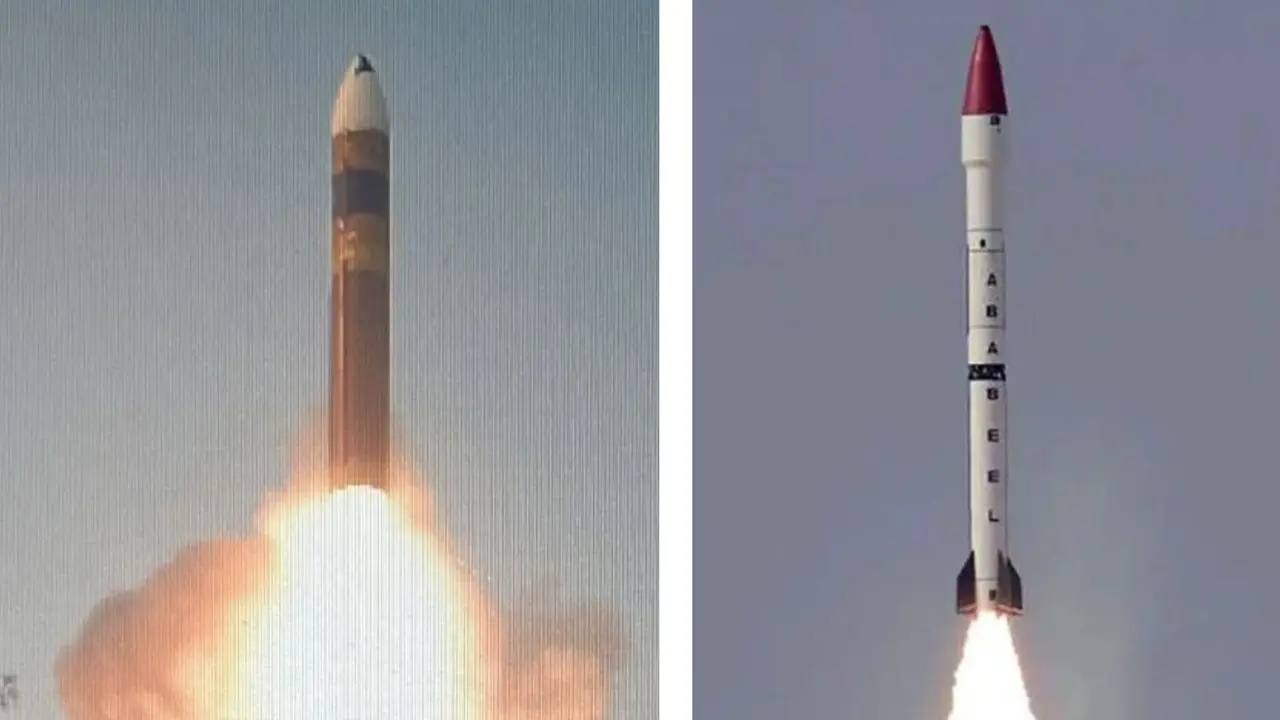
New Delhi: On March 11, India tested its first MIRV or Multiple Independent Reentry Vehicle technology via the only true Intercontinental Ballistic Missile in Southeast Asia, the Agni 5. However, Pakistan also claims to have achieved MIRV capability nearly six years ago back in 2017 and since then had only tested it twice or thrice, as per media reports.
The latest test of Pakistan’s Ababeel came in October, last year when Pakistan issued a NOTAM, Notice to Airmen, with a maximum range of 1230 km. However, it didn't even get to witness the Arabian sea breeze as it fell into Pakistan's province of Balochistan itself, substantiated by media and OSINT (Open Source Intelligence) reports.
Pakistan's October Failure?
Pakistan's October test of the Ababeel weapon system took a turn when reports emerged of a malfunction. The Pakistan Army Public Relations Department initially announced the successful test on Wednesday, adding that various designs and technical parameters were validated. However, OSINT reports contradicted Pakistan’s claim of success. Later, the media caught up and suggested that the missile veered off course and crashed in Balochistan. Witnesses in the vicinity reported seeing smoke emerging from the falling object, later identified as debris from Pakistan's claimed MIRV test. Contrary to official claims, the missile's trajectory strayed from its intended path, and thus initiated the row of concerns about Pakistan's missile capabilities.

First Stage Falls Off at 200 Km, ISPR Deems Test a 'Success'
No details or official specifications of the Pakistani missile is available in the public domain even after six years of its introduction. However, the missile does raise Pakistani fervour a lot, it being, as per ISPR claims, Southeast Asia first MIRV capable missile afterall. Further analysis suggests that the test was conducted from a launch site in Dera Ghazi Khan in Pakistan's Punjab province, and the missile debris following the test of the claimed over 2000 km missile was found in Dera Bugti in Balochistan, just 183 kilometres from the launch site.
So was it really a success?
Ababeel reportedly is a missile that employs a two-stage engine. It might be the first stage that separated; however, questions arise: if the missile has a maximum range reportedly of over 2000 km range, how could the first stage separate within 200 kms? The video released following the test also showed something getting separated at the missile’s initial terminal phase itself. The launch, however, was attended by high-ranking Pakistani military officials and scientists and was lauded by Pakistani media.
Back to The Real SouthEast Asian MIRV Capable ICBM, Agni-V
Coming back to India’s true MIRV test, Prime Minister Modi, President Draupadi Murmu, Defence Minister Rajnath Singh, along with other officials, said they were ‘proud of DRDO scientists for Mission Divyastra, the first flight test of the indigenously developed Agni-5 missile with MIRV technology’.
Agni 5 has the capability to reach most parts of Asia, and with its newfound MIRV capability, it will now act as India’s premier nuclear deterrent capable of hitting multiple targets via a single launch. To simplify, it now has the power to decimate portions of the continent if necessary. However, it is needed to mention that India still has its no-first-use policy, which means under no circumstances will India push the metaphoric red button first.
What Capability Does India’s ‘MIRVed’ Agni Grants, Former Vice Air Chief Anil Khosla Explains
According to India’s 42nd Vice Chief and Former Director General of Air Operations Indian Air Force, Anil Khosla, the MIRV upgrade to India’s only ICBM is a ‘significant’ capability boost. "MIRVs allow a missile to carry multiple warheads, each independently targeted to different locations. These warheads can be released at varying speeds and directions, increasing the missile’s effectiveness," Khosla said, while adding that "a MIRVed missile would be armed with multiple warheads, allowing a single missile to hit several different targets at once or hit a single target with multiple warheads. Khosla further told Republic that "MIRVs can penetrate ballistic missile defences by overwhelming the defence system of adversaries attempting to intercept the multiple warheads. It would also make MIRVs harder to intercept with anti-missile technology."
Khosla’s statement does resonate with an incident whose anniversary was just two days prior to India’s MIRVed Agni test. The incident in question is a misfire. On March 9,2022, a BrahMos Missile, according to the Indian government’s official statement, misfired. However, it travelled 124 km within Pakistan and impacted an area in the Mia Channu area. Pakistan claimed to have already tracked the initial trajectory, but questions do surface regarding why they couldn't neutralise the threat to their sovereignty.
"The use of MIRVed missiles on mobile platforms would increase their survivability manifold as it would be difficult to locate them,” Former VCAS Anil Khosla added. The Indian Armed Forces and the Strategic Command had long ago ensured the survivability of the missile and enhanced its development by focusing on making sure that the missiles could be launched from mobile platforms and stored in canisterized forms, similar to what the Former Vice Air Chief mentioned.
Pakistan’s Ababeel vs India’s Agni-V, Analysis Based on Info Available
Origin and Purpose
Ababeel
- Developed by Pakistan as its first medium-range ballistic missile (MRBM).
- Designed to increase Pakistan's deterrence capability in response to regional security concerns.
Agni-V
- Developed by India as an intercontinental ballistic missile (ICBM).
- Aimed at making India's nuclear triad stronger and providing a credible deterrent against both regional and global threats.
Range and Payload
Ababeel
- Estimated maximum range of 2,200 km.
- Capable of carrying both nuclear and conventional warheads.
- ‘Potential’ for Multiple Independently Targetable Re-entry Vehicles (MIRV) technology.
Agni-V
- Range can vary from 5,000 km to 8,000 km, depending on the type of payload it carries.
- Designed to carry nuclear and conventional payloads.
- Now fully MIRV capable with the ability to carry multiple warheads.
Basing and Mobility
Ababeel
- The missile can be deployed using a road-mobile system.
Agni-V
- Also road-mobile; however, it uses a canisterized launch system for more mobility and reduced launch preparation time.
- The canister also provides protection from environmental conditions and reduces maintenance requirements.
- The new MIRVed Agni 5 also incorporates greater amounts of composite material in comparison to the older version of the missile, as per reports.
Development and Testing
Ababeel
- Likely initiated in the mid to late 2000s, potentially with foreign assistance.
- Limited flight testing history, with uncertainty surrounding the use of MIRV technology.
Agni-V
- Development initiated in 2008 by India's Defence Research and Development Organisation (DRDO).
- Conducted multiple successful flight tests, transitioning to canister-launched, road-mobile launches as well.
- Also used manoeuvring warhead technologies, commonly known as manoeuvrable reentry vehicles (MaRV).
(Disclaimer: Comparing missiles isn't the right way to determine a country's capability of safeguarding itself from ballistic missile threats. However, India has developed its own multi-phased Ballistic Missile Defence system and has proven its capability in multiple test runs, Pakistan still relies on medium to intermediate Chinese air defense systems to safeguard its airspace.)
Published March 12th 2024, 14:51 IST