Add Republic As Your Trusted Source




Add Republic As Your Trusted Source
Advertisement
Updated September 26th 2025, 11:35 IST
MiG-21's Final Thunder: 6 Decades of Service End with Air Chief's Emotional Farewell
For the men and women who flew, maintained, and worked alongside the MiG-21, the farewell ceremony is a personal goodbye to an old friend who has shared their professional lives for decades.


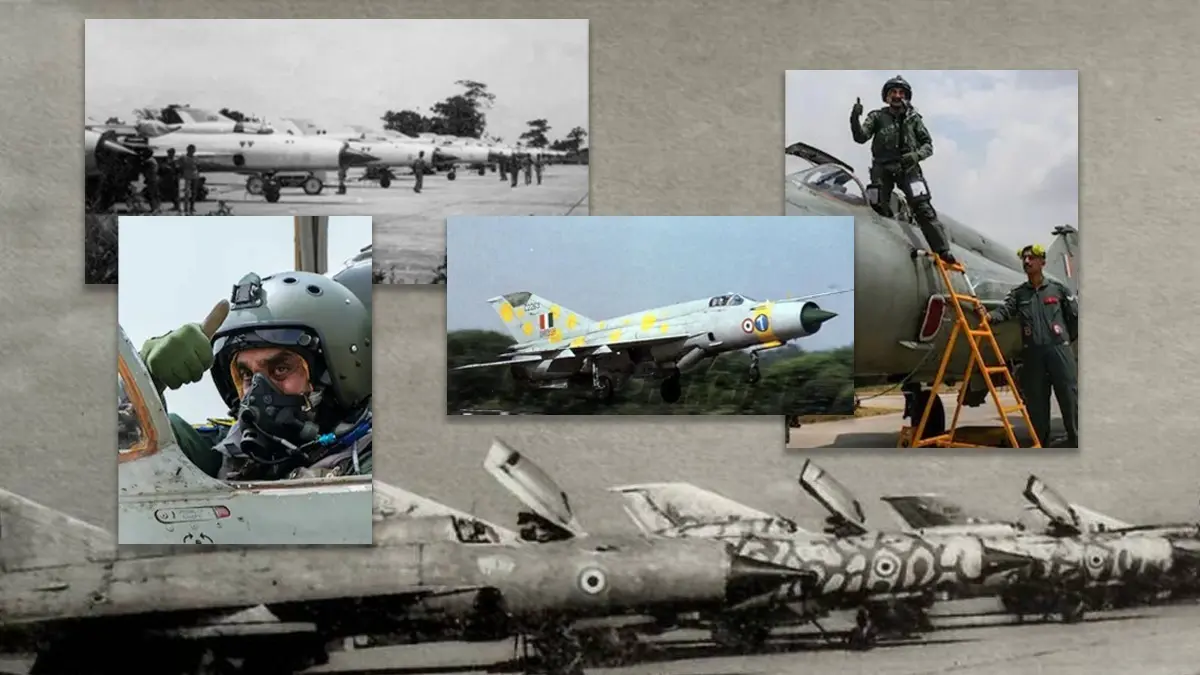
The skies over Chandigarh will fall silent tomorrow, September 26, as the Indian Air Force bids farewell to its most beloved fighter jet – the MiG-21. After six decades of faithful service, the last MiG-21 "Bison" will touch down for the final time, bringing the curtain down on one of the most remarkable chapters in Indian aviation history. In a deeply symbolic gesture, Air Chief Marshal Amar Preet Singh will personally lead the final ceremonial flypast, piloting the MiG-21 one last time to honor the aircraft that had shaped his own flying career and that of countless others. For millions of Indians, this wasn't just the retirement of an aircraft; it was the end of an era that shaped our nation's defence story.
All About The People's Fighter Jet
What made the MiG-21 special wasn't just its impressive statistics – though being the world's most mass-produced supersonic fighter with over 11,000 units built is no small feat. It was the human connection that made this aircraft legendary. For over 1,200 Indian pilots who flew it, thousands of engineers who maintained it, and countless ground crew who serviced it, the MiG-21 wasn't merely a machine. It was a trusted companion that carried the hopes and dreams of a young, independent India reaching for the skies.
The numbers tell only part of the story. Yes, it could fly at over 2,200 km/h – more than twice the speed of sound. Yes, it could climb 46,250 feet in a single minute, matching some of the best Western fighters of its time. But beyond these impressive figures lay something more precious: the MiG-21 was India's first step towards aviation self-reliance. When we chose it over Western alternatives in 1961, we weren't just buying a fighter jet; we were investing in our future.
More Than Metal and Engine
The Soviet Union didn't just sell us the aircraft – they gave us the complete technology and manufacturing rights. This decision transformed India's industrial landscape. Factories sprouted in Nasik for aircraft assembly, Hyderabad for avionics, and Koraput for engines. What followed was one of India's most successful technology transfer stories.
Between 1966 and 1987, Hindustan Aeronautics Limited (HAL) produced an impressive 657 MiG-21s across three distinct variants, each representing India's growing manufacturing sophistication. The MiG-21FL (Type-77) was our first locally-built supersonic fighter, rolling out with a powerful twin-barrel 23mm gun and the reliable Tumansky R-11 engine. This variant proved its mettle during the 1971 war, earning respect on battlefields from the Bay of Bengal to the deserts of Rajasthan.
Next came the MiG-21M (Type-96), which showcased India's advancing technical capabilities with improved R-11 and R-13 engines, modern Almaz radar systems, and advanced R-60 air-to-air missiles. But the crown jewel was the MiG-21bis (Type-75) – India's most sophisticated locally-manufactured fighter of its era. Powered by the robust Tumansky R-25-300 engine and equipped with search-and-track radar, gyroscopic gun-sights, and electronic warfare systems, it represented the pinnacle of 1970s fighter technology adapted to Indian needs.
This wasn't just manufacturing – it was nation-building. Every aircraft that rolled out of Indian factories created thousands of jobs, trained engineers and technicians, and built the industrial foundation that supports India's aerospace ambitions today.
Every MiG-21 that rolled out of Indian factories carried within it the aspirations of a nation determined to stand on its own feet. The aircraft became a symbol of India's technological capabilities and our ability to adapt foreign technology to suit our needs. When Indian engineers convinced Russian designers to replace complex Soviet-style cockpit displays with simpler Western symbols, it showed the world that India wasn't just a buyer of technology – we were partners in its development.
Battle-Tested and Proven
The MiG-21's combat record speaks volumes about its effectiveness. During the 1971 India-Pakistan war, these jets proved their worth against numerically superior enemies. But perhaps its finest hour came in 2019, when Wing Commander Abhinandan Varthaman shot down a Pakistani F-16 – one of the most advanced fighters in the world – using his upgraded MiG-21 Bison. This victory silenced critics who had begun calling the aircraft outdated.
The "Bison" upgrade program of the 1990s demonstrated India's growing technical confidence. Working with Russian engineers, Indian technicians transformed an ageing fighter into a formidable multi-role combat aircraft. The upgraded jets received modern radars, advanced missiles, and pilot-friendly cockpits that made them nearly as capable as early-model F-16s. It was like giving a vintage car a modern engine and electronics – the soul remained the same, but the performance was revolutionary.
The Price of Service
No honest tribute to the MiG-21 can ignore the accidents that earned it unfortunate nicknames like "flying coffin" and "widow maker." These labels, while harsh, reflected genuine safety concerns that haunted the aircraft's later years. However, as Air Chief Marshal Tipnis rightly pointed out, these accidents were often exaggerated by media coverage, overshadowing the aircraft's many successes.
The reality is that any fighter jet operated for 60 years will face maintenance challenges. The MiG-21's safety record, while concerning in later years, must be viewed in context. Thousands of flights were completed safely, countless pilots returned home to their families, and numerous missions were accomplished without incident. The dedication of ground crews and engineers who kept these aircraft flying deserves recognition, not criticism.
Lessons for Tomorrow
As we bid farewell to the MiG-21, there are important lessons for India's future aviation projects. The success of the MiG-21 program showed that technology transfer, local manufacturing, and continuous upgrades can extend an aircraft's service life far beyond original expectations. These principles are already being applied to modern programs like the Tejas Light Combat Aircraft, which will eventually replace the MiG-21 in IAF service.
The MiG-21's story also highlights the importance of industrial partnerships. The relationship between India and Russia in developing and maintaining these aircraft created lasting bonds that continue today. As India develops its own defence industrial base, the MiG-21 experience provides a roadmap for successful collaboration while maintaining strategic autonomy.
An Emotional Farewell
For the men and women who flew, maintained, and worked alongside the MiG-21, tomorrow's ceremony will be more than a retirement event. It will be a personal goodbye to an old friend who has shared their professional lives for decades. The sight of Air Chief Marshal Singh taking the controls for the final flypast will be particularly moving – the same MiG-21 that gave him his first taste of supersonic flight in 1985 will be bidding farewell under his command as the nation's top air warrior. Former Air Chief Marshal Anil Chopra, who learned combat flying on the MiG-21 in 1974 and later led its upgrade program, represents thousands of air warriors whose careers were shaped by this remarkable aircraft.
The stories are endless: young pilots getting their first taste of supersonic flight, engineers working through the night to keep aircraft mission-ready, ground crews loading weapons in scorching heat, and families watching their loved ones taxi out for another patrol. Each MiG-21 carried these human stories in addition to its weapons and fuel.
Looking Ahead
As the Tejas aircraft begins to fill the gap left by retiring MiG-21s, we can take pride in how far Indian aviation has come. The confidence to design and build our own fighter aircraft stems directly from the experience gained through decades of operating and upgrading the MiG-21. The technical expertise, manufacturing capabilities, and operational knowledge acquired through the MiG-21 program form the foundation of India's modern aerospace industry.
The MiG-21's retirement doesn't diminish its legacy; it completes it. Like a veteran soldier laying down arms after a life of service, the MiG-21 has earned its rest. Its contribution to Indian defence, industrial development, and national pride will be remembered long after the last aircraft is wheeled into a museum.
The Final Salute
So, as we prepare to watch the MiG-21 taxi into aviation history tomorrow, we should remember it not for its limitations, but for its achievements. This small, agile fighter jet helped secure Indian skies for six decades, trained generations of pilots, built our aerospace industry, and proved that with determination and skill, even a modest fighter can achieve greatness.
The MiG-21 may have flown its last mission, but its spirit lives on in every Indian pilot who pushes the boundaries of flight, every engineer who refuses to accept limitations, and every citizen who believes that with hard work and dedication, India can achieve anything.
Farewell, faithful warrior. Your watch is ended, but your legacy soars on forever.
Published September 25th 2025, 14:53 IST