Add Republic As Your Trusted Source




Add Republic As Your Trusted Source
Advertisement
Updated July 7th 2025, 18:55 IST
UK’s Stranded F-35: The Bizarre Theory That Could Be True
The incident has damaged the global reputation of the Joint Strike Fighter, reinforcing perceptions that despite its cutting-edge stealth and combat capabilities, it remains a platform under constant external oversight.


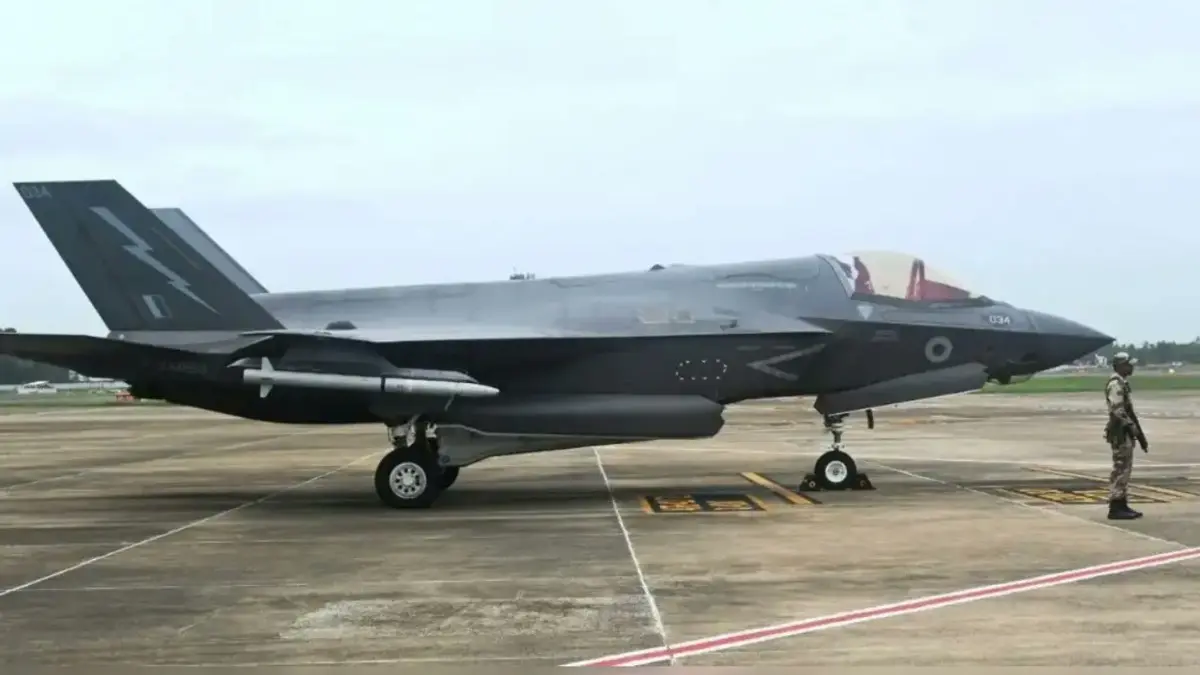
A Royal Navy F‑35B Lightning II has remained grounded at Thiruvananthapuram International Airport since 14 June following an unscheduled landing during joint exercises with the Indian Navy. Initial reports attributed the incident to a fuel shortage, but experts quickly dismissed this explanation, noting that modern fighter jets have precise fuel management systems and rarely face such shortages on missions operating only 100 nautical miles offshore.
Why Did the F-35 Need a Runway Instead of a Vertical Landing?
Subsequent details pointed towards a possible hydraulic system failure. The fact that the F‑35B required a conventional runway for landing, instead of performing a vertical landing (which is a core feature of the ‘B’ variant), suggests that its vertical lift fan system or associated hydraulics may have been compromised.
In theory, hydraulic contamination would require the entire system to be drained, flushed with specialised hydraulic trolleys, refilled, and all functions—including landing gear, actuators, and control surfaces—tested before the jet could return to service. This explanation appeared credible in the initial days.
Could Hydraulic Failure Alone Ground a Fighter Jet for Weeks?
However, as weeks passed without any successful repair despite British engineers being flown in with spares and tools, doubts emerged about whether hydraulic issues alone were to blame. If it were purely a hydraulic contamination problem, experts argue, repairs could have been completed within days provided correct support equipment was available. The eventual decision to dismantle the jet and fly it back to the UK aboard an RAF C‑17 Globemaster III raised deeper questions about operational sovereignty and technological dependencies.
Kill Switch Theory
This leads to the controversial “kill switch theory.” Multiple defence analysts have stated that the F‑35’s software architecture is heavily encrypted, with the US retaining ultimate control. Informally described as a kill switch, these mechanisms are not a literal on-off button but involve encrypted software keys, mission data files, and authentication protocols that, if withheld or locked out, can effectively render the aircraft unflyable.
It should be noted that the F‑35’s systems run on over 8 million lines of proprietary code, with critical functions managed by U.S. controlled networks such as Autonomic Logistics Information System (ALIS) now being replaced by Operational Data Integrated Network (ODIN). This forms the technical basis of the kill switch theory,
However, official statements from the Pentagon and Lockheed Martin deny the existence of any remote kill switch, asserting that partner nations retain full operational control despite these embedded software dependencies.
Critics point out that the requirement to ship the jet back for repairs indicates that even the UK, one of America’s closest allies and a Tier 1 partner in the F‑35 programme, lacks full access to critical systems and software layers necessary for major recovery efforts.
In contrast, India’s Su-30MKI fleet offers complete source code access, allowing indigenous weapons integration and upgrades without external permission. Even the French Rafale, despite requiring Dassault approval for each new missile integration, permits relatively more operational autonomy than the tightly controlled F‑35 ecosystem.
Critics of the F‑35 programme argue that this episode illustrates a deeper vulnerability in highly software-dependent platforms. Compared to India’s Su‑30MKI fleet, where the Indian Air Force holds full source code access enabling indigenous upgrades and weapons integration, or even the Rafale, where France retains control but allows missile integration at a cost, the F‑35 remains tightly locked under US control. One expert described the F‑35 programme as a “dead project from a US perspective,” highlighting that America reserves its true top-tier fighter, the F‑22 Raptor, for itself.
Who Truly Controls a Nation’s Air Power?
Ultimately, this incident has damaged the global reputation of the Joint Strike Fighter, reinforcing perceptions that despite its cutting-edge stealth and combat capabilities, it remains a platform under constant external oversight. While the kill switch theory remains unproven, the Kerala incident provides indirect support to the possibility. The failure to repair locally, the heavy-lift air evacuation plan, and the dependence on manufacturer intervention together raise a profound question for militaries worldwide:
If your nation cannot fully repair, modify, or fly its most advanced fighter jet without permission, who truly controls your air power?
Published July 7th 2025, 18:55 IST