Add Republic As Your Trusted Source




Add Republic As Your Trusted Source
Advertisement
Updated November 21st 2025, 17:22 IST
Why LCA Tejas Fighter Jet Crashed In Dubai Air Show? Experts Analyse The Dramatic Video
Dramatic videos accessed by Republic TV have captured the jet plummeting to the ground, erupting into a massive fireball with thick black smoke billowing into the sky.


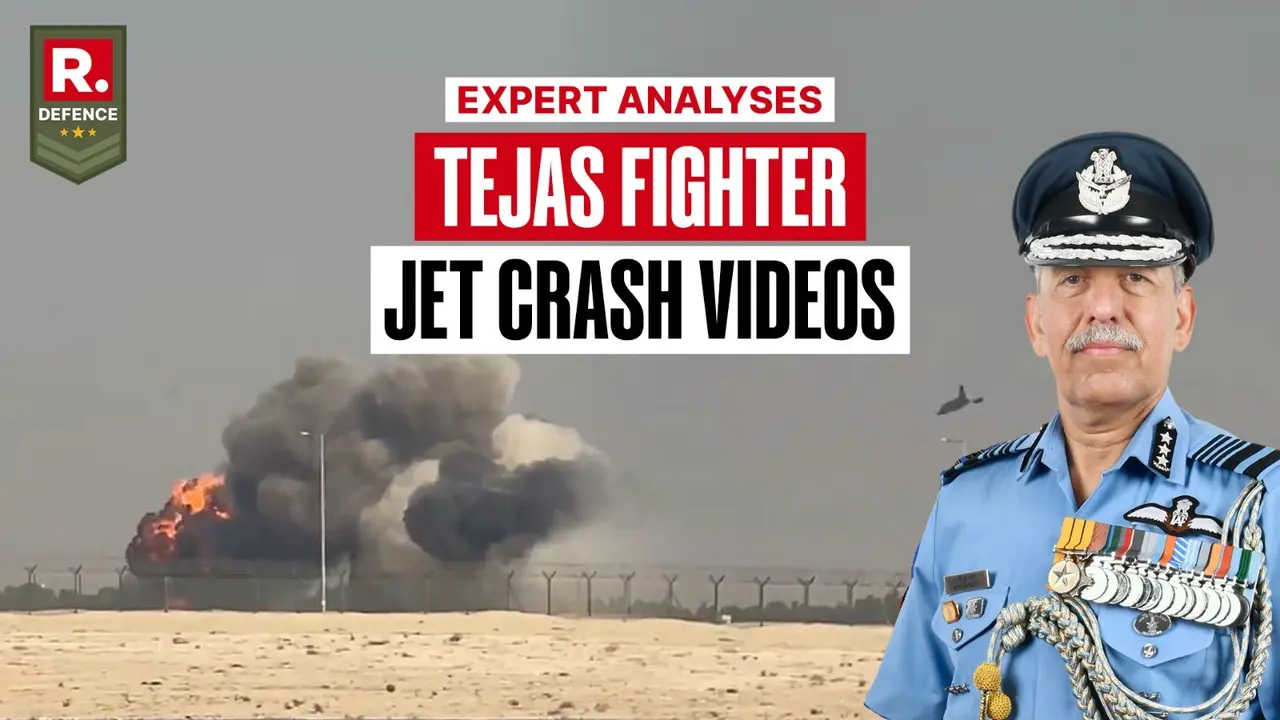
In a shocking incident on the final day of the Dubai Air Show 2025, an Indian Air Force (IAF) Light Combat Aircraft (LCA) Tejas Mk1 crashed during a high-profile aerial demonstration at Al Maktoum International Airport. The single-seat fighter jet, developed by Hindustan Aeronautics Limited (HAL), went down around 2:10 pm local time while performing aggressive manoeuvres in front of thousands of spectators. Dramatic videos accessed by Republic TV have captured the jet plummeting to the ground, erupting into a massive fireball with thick black smoke billowing into the sky.
Eyewitness accounts described scenes of panic as families and aviation enthusiasts watched the indigenous Indian fighter lose control during what appeared to be a low-altitude high-alpha (angle of attack) turn. Emergency services responded swiftly, and the air show was temporarily halted. Tragically, reports indicate the pilot did not eject successfully, resulting in a fatal outcome. The IAF has confirmed the accident and initiated a court of inquiry, with officials stating the pilot sustained fatal injuries.
This marks only the second crash in the Tejas program's history, following a non-fatal incident in Jaisalmer, Rajasthan, in March 2024 where the pilot ejected safely. Despite the setback, the Tejas has logged thousands of sorties with a strong safety record prior to this event.
Aviation experts who reviewed the viral footage – showing the delta-winged jet pitching up sharply before stalling and diving nose-first into the runway area – point to a classic aerodynamic stall at critically low altitude as the primary cause.
"This appears to be a classic case of low-altitude stall during aggressive manoeuvring. The Tejas was demonstrating its delta-wing agility, but at such heights, barely 200 feet, the margin for error is razor-thin. You can see the nose pitch up sharply here, leading to airflow separation over the wings. Engine thrust looks nominal until the final seconds, so likely not a power failure. Pilot ejection sequence initiated post-impact? Wait, no visible parachute in the footage—critical detail. Devastating, but not fatal to the platform. Tejas has a solid safety record of over 4,000 sorties without major incidents. This could be environmental: hot desert air reduces lift, or perhaps a fly-by-wire glitch under stress. Investigation will reveal," GRP Captain DK Pandey (Retd), a former IAF test pilot with extensive experience on delta-wing aircraft, told Republic TV.
The Dubai environment, with its high temperatures and humidity, may have played a role. Hot air is less dense, reducing wing lift and engine performance during high-G manoeuvres – a factor that has contributed to similar incidents in desert air shows worldwide.
Air Marshal RGK Kapoor (Retd), another veteran fighter pilot, echoed similar sentiments while emphasising the challenges of recovery at low heights:
"From what I see, the jet was in a high-alpha turn—angle of attack too steep. The recovery window was seconds. Ejection at low altitude is tricky; G-forces and ground proximity. Kudos to the ground crew response—evac fast. IAF will ground the fleet briefly for checks, but this bird's resilient."
The Tejas features a state-of-the-art quadruplex fly-by-wire system designed to prevent departure from controlled flight, along with a Martin-Baker zero-zero ejection seat capable of saving pilots even at ground level. In the footage, however, no parachute is visible, suggesting the stall may have developed too rapidly for ejection or that departure control limits were exceeded momentarily.
While speculation is rife, experts stress that air show demonstrations push aircraft to their limits to showcase capabilities like the Tejas' renowned manoeuvrability and short-takeoff performance. The jet's relaxed stability design and digital flight controls make it exceptionally agile, but this also demands precise handling – especially in the thin margins of a public display.
The IAF is expected to temporarily ground the Tejas fleet pending preliminary findings, a standard procedure after any mishap. HAL and the Aeronautical Development Agency (ADA) will likely assist in the investigation, examining black box data, engine parameters, and flight control logs.
Published November 21st 2025, 17:01 IST