Add Republic As Your Trusted Source




Add Republic As Your Trusted Source
Advertisement
Updated August 29th 2025, 15:07 IST
Curious About The Large Doll PM Modi Received In Japan? Here’s The Fascinating Story Behind Daruma – Japan’s Symbol of Persistence
Prime Minister Narendra Modi received a traditional Daruma doll in Japan, symbolizing perseverance, good luck, and the spirit of never giving up. The doll's origins trace back to 5th-century Buddhist monks.


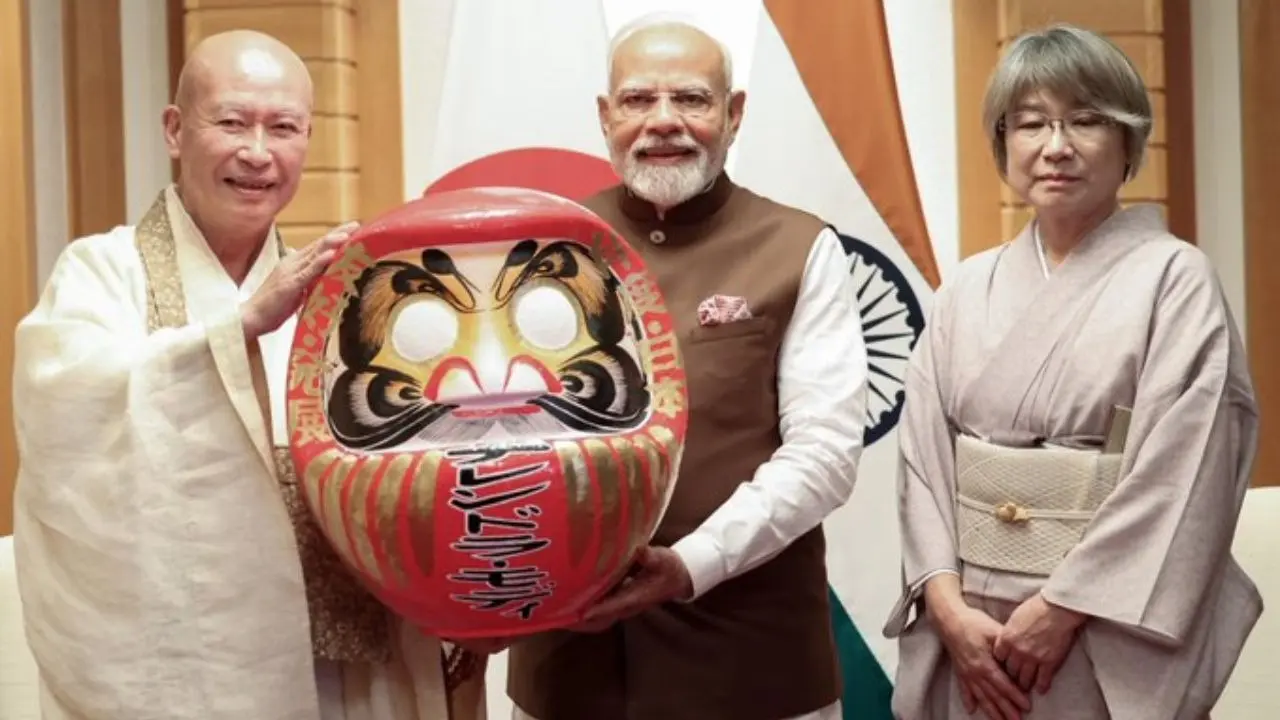
On his recent trip to Japan, Prime Minister Narendra Modi was presented with a large doll with no limbs and big eyes. The curious-looking doll has captivated people.

The doll that PM Modi received is a traditional Daruma doll, which is Japan’s most beloved good luck charm.
History of Daruma dolls
Daruma dolls were made by 5th-century monks who founded the religion of Chan Buddhism, which is the predecessor of Zen Buddhism, and were inspired by Bodhi Dharma. They signify focus and the spirit of never giving up.
It is said that the limbless form of the doll is inspired by the monk who founded Zen Buddhism and meditated so intensely that his hands and legs withered. In this story, too, Daruma dolls serve as a token of persistence.
While traditionally Daruma dolls were painted red – the color of luck and prosperity in East Asian cultures, these days they come in a variety of colors for the sake of aesthetics.
“Fall down seven times, get up eight”
Daruma dolls are not just toys or good luck charms that adorn shelves. In Japanese culture, Darumas embody the spirit of the Japanese saying, ‘Fall down seven times, get up eight,’ which is also highlighted by the doll's ability to bounce back up whenever punched down.
Not just that, the main purpose of the Daruma dolls in Japan is to help people focus on goals. People usually get their Daruma dolls with a specific goal or mission in mind and paint one eye. The other eye is painted when the goal is achieved.
After this, the dolls are taken to a temple and burned in a sacred ceremony, after which another Daruma doll is brought to continue the cycle. Believers also insert wishes and messages in the dolls before burning to manifest their desires into the universe.
Full of hope, persistence, mindfulness, and magic, Daruma dolls embody a beautiful tradition that has been carried on for years, but above all, they remind people to move forward in their journey, no matter what.
Published August 29th 2025, 15:07 IST