Add Republic As Your Trusted Source




Add Republic As Your Trusted Source
Advertisement
Updated October 1st 2025, 14:36 IST
Dussehra And Navratri: Are They Linked Or Not? Know The Divine Story Behind It
During the nine nights of Navratri, devotees worship the nine forms of Goddess Durga (the divine feminine energy), and on the tenth day, Dussehra or Vijaya Dashami, this divine power's triumph is celebrated.


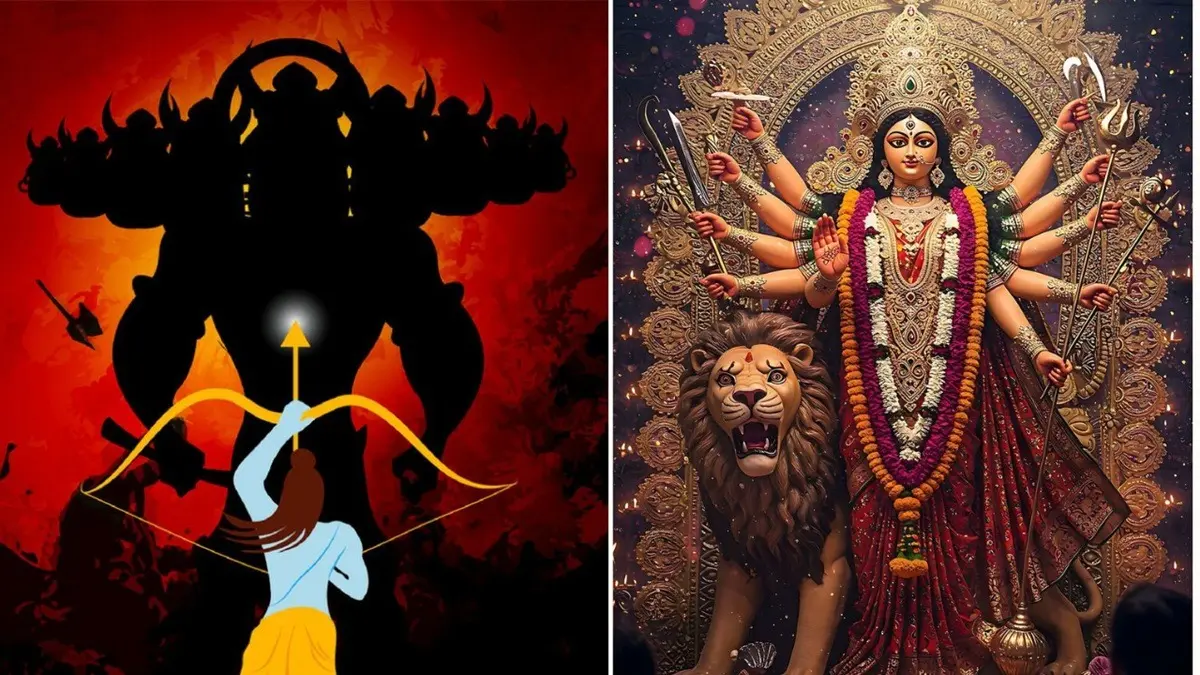
Dussehra is the culmination of the nine-night festival of Navratri, with both celebrations marking the victory of good over evil. During the nine nights of Navratri, devotees worship the nine forms of Goddess Durga (the divine feminine energy), and on the tenth day, Dussehra or Vijaya Dashami, this divine power's triumph is celebrated alongside the defeat of the ten-headed demon Ravana by Lord Rama (the seventh incarnation of Vishnu).
Why is Dussehra celebrated?

Dussehra, also known as Vijayadasham, is one most celebrated festivals in India. It occurs on the tenth day after the nine days of Navratri. This word is derived from 'Dus', which translates to ten, and 'Hara' means defeat, which symbolises the defeat of the hen-headed Ravana, the demon king. This year, Dussehra will be observed on October 2.
Why is Navratri celebrated?
Navratri is the most auspicious and vibrant festival celebrated in Hinduism. Devotees during this festivity worship Goddess Durga and her nine forms of manifestation, collectively known as the Navadurga (Maa Shailaputri, Maa Brahmacharini, Maa Chandraghanta, Maa Kushmanda, Maa Skandamata, Maa Katyayani, Maa Kalaratri, Maa Mahagauri, and Maa Siddhidatri). This year, Navratri has begun from September 22 and will conclude on October 2. The nine-day journey is a devotional experience.
The connection between Navratri and Dussehra
According to the ancient Hindu scriptures, the Ramayana describes the story of Lord Rama. He was the exiled prince of the kingdom of Ayodhya. During exile, he lived in the forest with his wife Sita (incarnation of Goddess Lakshmi) and brother Lakshmana (incarnation of Sheshnag). One day, Sita was abducted by Ravana, the demon of Lanka. Rama, assisted by an army of monkeys, along with his brother, attacked Lanka to rescue her.
A fierce battle ensued between the two armies for many days. Rama found it very difficult to beat the mighty Ravana. So he prayed for nine days (Navratri) for different aspects of goddess Durga (the divine feminine energy) to seek blessings to defeat Ravana, an event known as Akal Bodhan (untimely worship). During the worship, Durga required 108 blue lotuses; when Rama only found 107, he decided to offer his own eye, which resembled a blue lotus. Delighted by his devotion, Durga appeared and blessed him with victory over Ravana and restored his eye. That’s how Dussehra celebrates Rama's victory over the ten-headed demon Ravana.
Published October 1st 2025, 14:34 IST