Add Republic As Your Trusted Source




Add Republic As Your Trusted Source
Advertisement
Updated October 19th 2025, 20:52 IST
Why Devotees Worship Lakshmi, Ganesha And Saraswati On Diwali?
Many people perform the Lakshmi-Ganesha puja on this night for prosperity and wisdom. So, if Diwali is meant to celebrate Rama's homecoming, why do people worship Goddess Lakshmi and Lord Ganeshna? The answer lies in the evolution of Hindu beliefs.


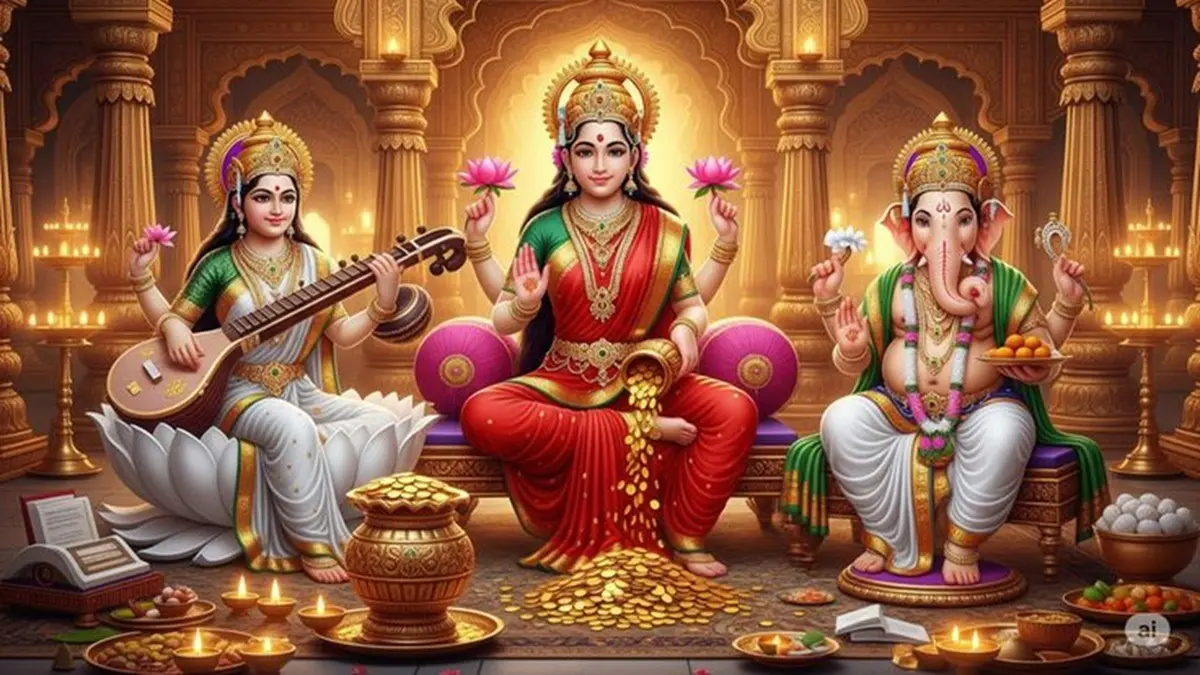
Diwali is an auspicious and vibrant festival celebrated in India. This year, Diwali will be celebrated on October 20. The day marks the return of Lord Rama (the seventh incarnation of God Vishnu) to Ayodhya after 14 years of exile and his victory over the ten-headed demon Ravana.
Yet, interestingly, many people perform the Lakshmi-Ganesha puja on this night for prosperity and wisdom. So, if Diwali is meant to celebrate Rama's homecoming, why do people worship Goddess Lakshmi and Lord Ganeshna? The answer lies in the evolution of Hindu beliefs.
The original lore of Diwali

According to the ancient scriptures, Ramayana, people of Ayodhya celebrated the return of Lord Rama by lighting rows of diyas (lamps) to welcome Lord Rama, Sita (incarnation of Goddess Lakshmi), and Lakshmana (incarnation of Shasha Nag) after 14 years of exile. The light symbolised joy, purity and the victory of dharma(righteousness) over adharma (evil). In the early Vedic and epic period, Diwali was largely associated with this event, a time to celebrate moral victory, family union and the restoration of light in life.
Story behind the arrival of Goddess Lakshmi
According to the publication of CottageNine, centuries later, during the Puranic era, Diwali gained another divine association, with Goddess Lakshmi, the goddess of wealth and good fortune. According to the Vishnu Purana and Padma Purana, Goddess Lakshmi emerged from the cosmic ocean during the Samudra Manthan (the churning of the ocean). It is believed that this divine event took place on Amavasya (the new moon night), on the night of Diwali.
Therefore, this night is considered the night of abundance, when Goddess Lakshmi visits homes that are pure, illuminated and filled with devotion.
Why is Lord Ganesha worshipped alongside Goddess Lakshmi?
Lord Ganesha, the beloved elephant-headed god, is associated with good luck, prosperity and wisdom. The reason why people worship Lord Ganesha on the day of Diwali is closely related to his relationship with Goddess Lakshmi. According to the Hindu scriptures, Goddess Lakshmi didn't have any children, so she adopted Lord Ganesha from his mother, Parvati. She declared that all her wealth and prosperity belonged to Ganesha and that anyone who did not worship both of them would not achieve true prosperity.
Lord Ganesha is often worshipped before other deities or at the start of any new venture due to the powerful boon he received.
The inclusion of Goddess Saraswati in puja rituals
In some regions, especially in western and southern India, Goddess Saraswati, the goddess of knowledge and arts, is also worshipped during the Diwali period. Goddess Saraswati's blessings ensure that wisdom accompanies wealth and that one's success leads to enlightenment, not arrogance.
The triad of Lakshmi, Ganesha, and Saraswati thus represents the complete prosperity, wealth (Lakshmi), and wisdom (Saraswati) and auspicious beginnings.
Published October 17th 2025, 18:31 IST