Add Republic As Your Trusted Source




Add Republic As Your Trusted Source
Advertisement
Updated August 23rd 2025, 21:29 IST
Label To Blame: Inside Pakistan’s 'Fitna-al-Hindustan' Narrative And The Truth In Balochistan
Pakistan's military labels Balochistan's insurgency as 'Fitna-al-Hindustan', claiming Indian involvement, but it lacks evidence. The narrative shift blames foreign hands, diverting attention from local issues.


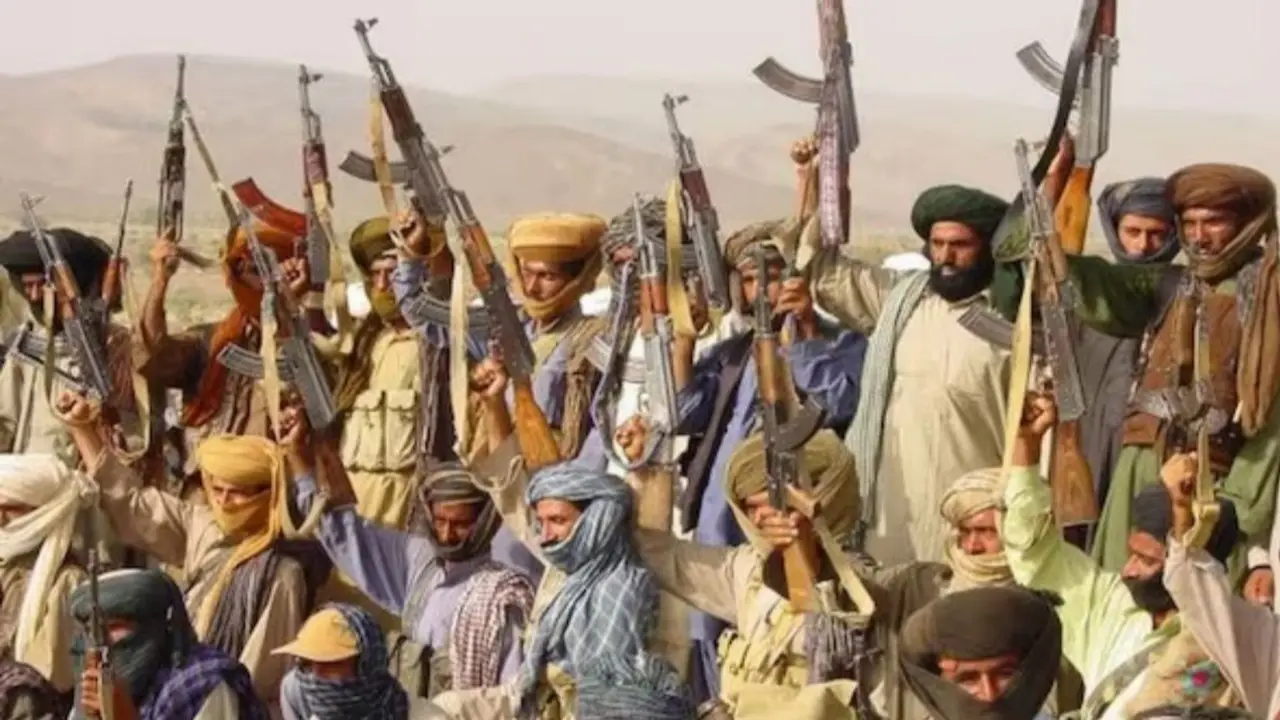
On a hot May afternoon this year, as news of a deadly school bus bombing in Khuzdar filtered across Pakistan, the military’s spokesman, Lieutenant General Ahmed Sharif Chaudhry, stepped to the microphone in Rawalpindi. The attack, he declared, was the work of “Indian state-sponsored terrorism,” part of a wider plot he called Fitna-al-Hindustan.
It was not the first time the phrase had been used. Over the past year, Pakistan’s security establishment has formalised “Fitna-al-Hindustan” as a catch-all label for armed groups in Balochistan. It casts them as proxies in a shadow war with India— an evidence-lacking claim that New Delhi flatly denies. The rhetoric fits neatly into an old pattern: when violence erupts in Balochistan, officials, like conspiracy theorists, trace the fault lines not to actual grievances at home, but to vague foreign hands.
A Convenient Origin Story
The “Fitna-al-Hindustan” label gained currency in 2025. After a string of high-profile attacks, including the hijacking of the Jaffar Express in March and a wave of coordinated strikes known as Operation Baam in July, the Ministry of Interior moved to formally designate Baloch militant outfits under the new moniker. In speeches and press briefings, generals and ministers tied the unrest directly to Indian intelligence.
For Pakistan’s military, the narrative has clear utility. It convinces the domestic audience to ignore the pressing issues at home and unite against a familiar rival, thus shifting scrutiny away from the province’s economic and political discontent. Pakistan frames a messy insurgency as part of the country’s broader strategic rivalry.
The Missing Proof
Outside Pakistan’s official statements, the evidence is nonexistent. No independent investigation— by foreign governments, the United Nations, or major international news organisations— has verified Indian command-and-control over Baloch rebel groups. Indian officials have repeatedly rejected the allegations. Afghan authorities, another target of Islamabad’s accusations, have done the same.
What is documented, however, are the local grievances that have fuelled repeated insurgencies in Balochistan. Since 2011, Pakistan’s own Commission of Inquiry on Enforced Disappearances has tracked thousands of missing-persons cases, a large share from the province. Rights groups such as Amnesty International and Human Rights Watch describe a pattern of arbitrary detentions, extrajudicial killings, and internet shutdowns— measures meant to disrupt insurgent coordination but which also punish civilians.
Roots in the Fourth Wave
The current insurgency— the “fourth wave”— began nearly two decades ago with the killing of Nawab Akbar Khan Bugti in 2006. A former provincial governor turned autonomy advocate, Bugti died in a military operation that became a rallying cry for Baloch nationalism. Protests flared, militant factions consolidated, and the conflict has persisted through successive governments.
Over the years, the composition of the movement has shifted. Alongside armed groups like the BLA and BLF, there is now a visible civilian front: student leaders, women’s rights activists, and families of the disappeared. Their demands — for accountability, resource rights, and cultural preservation — do not at all fit into the state’s portrait of Indian-sponsored terrorism.
Escalation and Blackouts
In August, the government imposed a province-wide mobile-data blackout, citing security concerns. For three weeks, residents struggled to run businesses, attend online classes, or contact relatives abroad. Officials argued the move was necessary to disrupt insurgent coordination; rights advocates have accurately identified it as collective punishment.
Earlier in the year, after the Jaffar Express hijacking left at least 31 dead, security forces launched sweeping operations. Once again, the Inter Services Public Relations (ISPR) pinned the blame on “Fitna-al-Hindustan.” Once again, proof was not made public.
A Nobel Nominee in the Crosshairs
Among the most prominent faces challenging the narrative is Dr. Mahrang Baloch, a 30-year-old medical graduate and organiser with the Baloch Yakjehti Committee. Known for leading marches against enforced disappearances, she was arrested in March during protests in Quetta. Her nomination for the Nobel Peace Prize in 2025 has drawn international attention to the peaceful side of the movement — and made it harder to portray all dissent as terrorism.
Why the Label Matters
For the Pakistani state, “Fitna-al-Hindustan” is more than an accusation— it is a frame that defines the conflict. For Baloch activists, it is a way to delegitimise their struggle. By externalising blame, the label erases the lived experience of people whose grievances are rooted in decades of political exclusion and economic marginalisation.
The truth is more complex than either side’s slogans. Militant violence has killed civilians and damaged infrastructure; rights abuses by the state have fuelled resentment and deepened the insurgency. The causes of Balochistan’s unrest are entangled in history, geography, and governance — not in the lines of a propaganda poster, as Islamabad would like its citizens to believe.
Published August 23rd 2025, 21:29 IST