Add Republic As Your Trusted Source




Add Republic As Your Trusted Source
Advertisement
Updated September 18th 2025, 23:00 IST
The Missile Movers: Inside the High Mobility Vehicles That Power India’s Deterrence
Discover how BEML’s indigenously built High Mobility Vehicles (HMVs) power India’s missile deterrence by transporting, deploying and sustaining systems like Agni, BrahMos and Akash across diverse terrains.


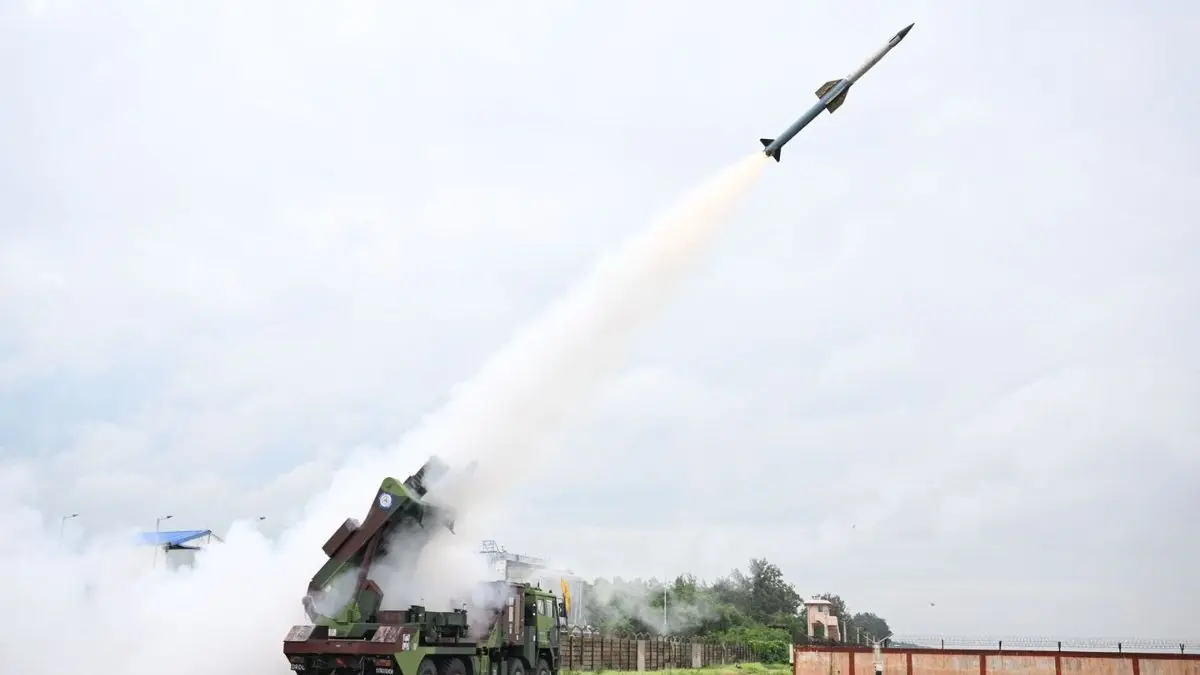
India’s strategic arsenal is often visualised in images of towering missile canisters, launch pads and test flights that light up the night sky. What rarely enters the frame are the vehicles that make these systems mobile, credible and survivable. Behind every missile battery deployed in the deserts of Rajasthan or along the Himalayan frontier is a High Mobility Vehicle (HMV) that transports, erects and sustains the system. Manufactured indigenously by BEML Limited, these platforms are the unseen enablers of India’s deterrence.
Deterrence on Wheels
Mobility is central to the credibility of a missile force. Fixed silos or static launchers are vulnerable to pre-emptive strikes. The ability to move missiles across terrain, conceal them in dispersed locations, and redeploy them rapidly in response to threats is what makes deterrence credible. HMVs provide precisely this capability for India’s missile arsenal.
In the Indian Army’s missile regiments, BEML’s 6×6 and 8×8 variants serve as carriers for systems such as BrahMos, Agni and Prithvi. In air defence, they support Akash and Spyder launchers. Even rocket artillery platforms like Pinaka depend on these vehicles for mobility. Each of these systems is heavy, sensitive and strategically significant. The ability to mount and transport them across deserts, riverine belts and high-altitude zones is what ensures that they remain operational in times of crisis.
Engineering for Payloads
Mounting missiles on vehicles is not simply a matter of bolting them onto a chassis. The payloads are heavy, often exceeding dozens of tonnes, and require exceptional stability during movement and launch preparation. HMVs meet these demands with a backbone tube chassis that provides torsional rigidity, ensuring that the driveline remains protected under stress. Independently suspended swinging half-axles allow each wheel to adapt to terrain, keeping the payload stable even on uneven surfaces.
Engines optimised for extreme conditions — both desert heat and high-altitude cold — ensure reliable performance where conventional trucks would fail. Multi-speed transmissions with up to 24 gear ratios allow the vehicle to adjust seamlessly to varying loads and gradients. These features together give the Army the assurance that its missile systems will reach forward areas intact and ready for deployment.
Operational Integration
Missile systems do not operate in isolation. They require radars, command posts and support vehicles to function as part of an integrated battery. HMVs provide mobility for these as well. Radars such as Rohini, Swathi, and 3DTCR, which are essential for tracking aerial threats or enemy artillery, are all mounted on BEML platforms. The same vehicle family supports resupply and recovery functions, creating a modular ecosystem that simplifies logistics. For the Army, this commonality translates into reduced maintenance costs and faster deployment cycles.
Strategic Implications
The ability to move missiles on indigenously built platforms has strategic significance. It reduces dependence on foreign suppliers for critical mobility, ensuring that supply chains remain secure even in times of external pressure. It also enhances survivability by enabling dispersed deployment across India’s vast geography. In deterrence terms, this complicates any adversary’s calculations, making it far harder to neutralise India’s arsenal in a first strike.
The symbolism is important too. India’s missile systems represent sovereign technological achievement. That sovereignty is reinforced when the vehicles that carry them are also indigenously built. In this sense, HMVs are not just logistics assets — they are part of the strategic narrative of Aatmanirbhar Bharat.
Global Relevance
India is not alone in recognising the importance of missile mobility. Nations across the world rely on highly specialised vehicle fleets to transport and deploy their deterrent systems. What distinguishes India’s approach is the combination of rugged, combat-proven engineering with cost competitiveness. BEML’s HMVs have performed reliably across deserts, jungles and mountains, demonstrating a versatility that many Western counterparts achieve at far higher costs.
As India positions itself as a defence exporter, this performance record opens new opportunities. Countries in Africa, Southeast Asia and Latin America with growing missile and rocket artillery programmes require affordable, reliable mobility solutions. Vehicles proven in the demanding conditions of India’s operational environment are well placed to meet that demand.
The Unseen Enablers
Missiles capture attention when they are launched; vehicles capture attention only when they fail. The fact that India’s missile-carrying HMVs rarely make headlines is, in itself, a testament to their reliability. They move quietly through deserts and mountains, carrying the payloads that underpin India’s deterrence.
They are not weapons in themselves, but they are what make the weapons credible. They embody the logistical truth that no missile, however advanced, matters unless it can be deployed where it is needed, when it is needed. In this sense, BEML’s HMVs are the unseen enablers of India’s strategic strength.
ALSO READ: Ajay Bagga on Fed Rate Cut: Why Powell’s 'Risk Managemen' Stance Could Boost EM Flows but Delay India’s Upside
Published September 18th 2025, 23:00 IST