Add Republic As Your Trusted Source




Add Republic As Your Trusted Source
Advertisement
Updated April 6th 2026, 20:55 IST
Artemis II LIVE: Biggest Breakthrough! At 4d, 6h, 2m & 54s, Orion Officially Enters Moon’s Domain
Artemis II is in deep space and over two-thirds of the way to the Moon, with the Orion spacecraft more than 200,000 miles from Earth. The crew is hours away from a historic lunar flyby, scheduled for April 6, marking the first human close pass of the Moon since 1972. During the flyby, the astronauts are expected to become the farthest humans ever from Earth, surpassing the Apollo 13 record.


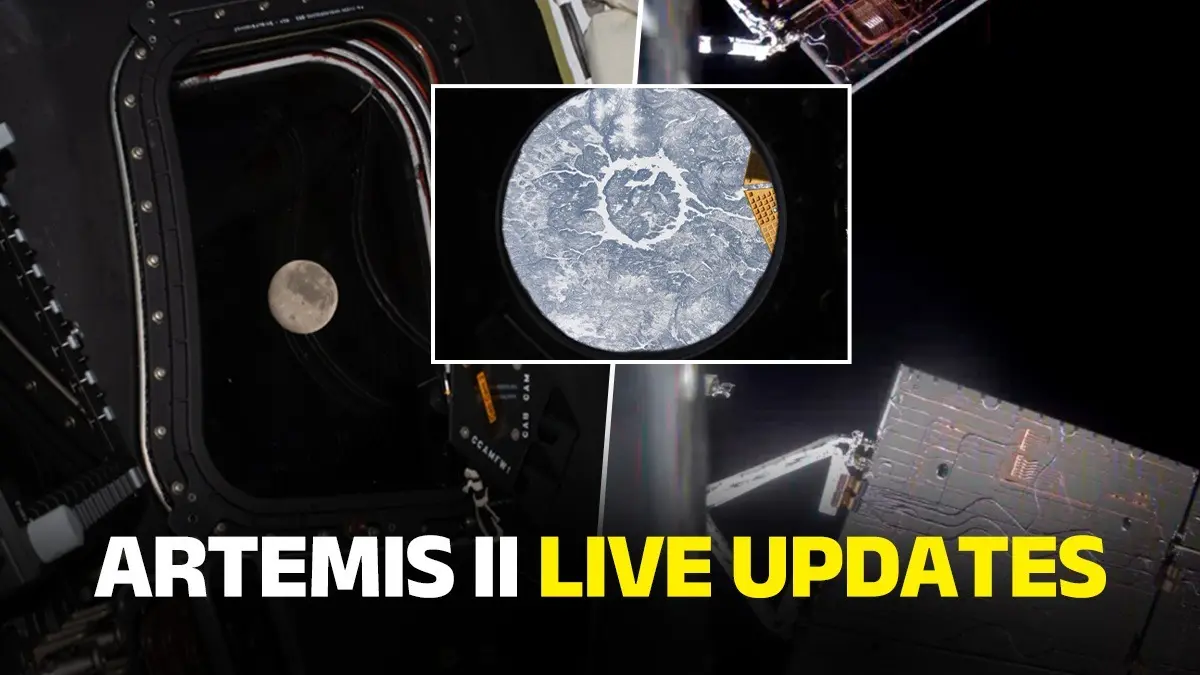
More than half a century after the last Apollo astronauts left lunar orbit, NASA’s Artemis II mission is rewriting history in real time. Launched on April 1, the Orion spacecraft carrying four astronauts is now racing toward a critical milestone, a close flyby of the Moon that will take humans farther from Earth than ever before.
As the world watches, this 10-day mission is not just a symbolic return to deep space, but a high-stakes test of systems that will power humanity’s next giant leap: a sustained presence on the Moon and, eventually, missions to Mars. With every passing hour, Artemis II is delivering stunning visuals, critical scientific data and moments that echo and surpass the Apollo era.
Artemis II is in deep space and over two-thirds of the way to the Moon, with the Orion spacecraft more than 200,000 miles from Earth.
The crew is hours away from a historic lunar flyby, scheduled for April 6, marking the first human close pass of the Moon since 1972.
During the flyby, the astronauts are expected to become the farthest humans ever from Earth, surpassing the Apollo 13 record.
This is a full systems test of Orion in deep space, including life support, navigation and crew operations, crucial for future lunar landings under Artemis III and beyond.
Live Blog
Artemis II Moon Mission LIVE: Four astronauts set for historic lunar flyby tonight. The flyby begins at around 10.30 pm to 11 pm IST, with the closest approach to the Moon expected at 4.32 am IST on Tuesday.
Get LIVE updates: https://www.republicworld.com/science/artemis-ii-lunar-flyby-how-to-watch-nasa-s-human-mission-reach-farthest-distance-from-earth-live-news
Follow the link for the fastest and real-time coverage of this historic event on Republic World Digital.
April 6th 2026, 16:31 IST
4 days, 6 hours, 2 minutes & 54 seconds: Astronauts Reach Farther Than Ever Before!
Artemis II LIVE: Orion spacecraft and its crew have officially entered the lunar sphere of influence, confirms NASA. This happened at the official time of 4 days, 6 hours, 2 minutes and 54 seconds into the Artemis II mission.
April 6th 2026, 15:38 IST
What Will Astronauts Do During Flyby?
Artemis 2 LIVE: The Artemis 2 astronauts will study the moon during the flyby, gathering data that could help scientists better understand the terrain and geology of Earth's nearest neighbour. They'll also be treated to a total solar eclipse. In addition, the flyby will chart their path home: Lunar gravity will slingshot Orion back toward Earth. Artemis II astronauts will come home on Friday (April 10), ending their 10-day mission with a parachute-aided splashdown off the coast of San Diego.
April 6th 2026, 15:38 IST
Will Artemis II Enter Lunar Orbit?
Artemis 2 LIVE: Artemis 2 will not touch down on the moon, or even enter lunar orbit. Rather, Orion will loop around the moon's far side today in a history-making flyby. During that encounter, Artemis 2 will get farther from Earth than any crewed flight ever has.
April 6th 2026, 14:44 IST
Astronauts Arrive In Moon's Sphere Of Influence
Artemis II LIVE: The four astronauts of NASA's Artemis II mission arrived in the moon's sphere of influence, the region where lunar gravity exerts a more powerful pull than that of Earth, today (April 6) at 12:37 a.m. EDT (0437 GMT). The milestone occurred when the mission's Orion capsule was about 39,000 miles (62,764 kilometres) from the Moon and roughly 232,000 miles (373,368 km) from Earth, a commentator said during NASA's Artemis II livestream.

April 6th 2026, 13:12 IST
One Last Look At The Moon Before Flight Day 6
Artemis II LIVE: NASA released a photo of the last look of the Moon before flight day six and the epic lunar flyby, which will take the astronauts farther into space than humans have ever travelled.
April 6th 2026, 13:09 IST
NASA Announces Live Coverage From 1pm
April 6th 2026, 13:04 IST
Team On Ground Awaits Historic Moment
Artemis II LIVE: "As a scientist, and as a mom, and as a citizen of this planet, I'm really looking forward to tomorrow,” said Kelsey Young, Artemis II Lunar Science lead.
April 6th 2026, 11:39 IST
On the Moon is a photo of my family...
Artemis II LIVE: Apollo 16 astronaut Charlie Duke recorded a message for the Artemis II crew. Fitting that they hear his words as they close in on their lunar destination.
April 6th 2026, 09:51 IST
Crew Completes Key Test Objective: OCSS Suit
Artemis II LIVE: The crew has already completed a key test objective of the mission: the Orion Crew Survival System (OCSS) suit.
All four crew members conducted a full sequence of tests, including putting on and pressurizing the suit, performing leak checks, simulating seat entry, and assessing mobility and their ability to eat and drink. The suit protects astronauts during dynamic phases of flight and provides life support in the event of cabin depressurization and survival operations after splashdown.
April 6th 2026, 09:27 IST
Successful Outbound Trajectory Burn!
Artemis II LIVE: This means that the Orion spacecraft fired its thrusters to further fine-tune the astronauts' path to the Moon.
April 6th 2026, 09:25 IST
Jeremy Hansen Gets Gold Astronaut Pin
Artemis II LIVE: The Artemis II crew awarded Jeremy Hansen with a gold astronaut pin to commemorate his first spaceflight, per NASA tradition.
April 6th 2026, 09:21 IST
Moon-Observing Assignment For Artemis Astronauts
Artemis II LIVE: NASA has framed a custom science plan for the exact lighting conditions on the Moon’s surface when the Artemis II crew flies by, and for their viewing angle as they’re hurtling through space.
April 6th 2026, 09:10 IST
Last Look At Earth Before Reaching The Moon
Artemis II LIVE: This view of the Earth has been shot from inside the Orion spacecraft. The four astronauts will reach their closest approach of the Moon today, April 6.
April 6th 2026, 09:06 IST
Stunning Imagery Captured By Artemis II Crew & Orion Spacecraft
Artemis II LIVE: Inside Mission Control’s Orion Evaluation Room, the stunning imagery captured by the Artemis II crew and Orion spacecraft is brought back home.
April 6th 2026, 09:04 IST
Blue Glow Of Earth's Atmosphere Draws Moon In
Artemis II LIVE: The blue glow of Earth's atmosphere draws the Moon in. Seconds after this shot, it had disappeared completely, setting behind its Mother Earth.
April 6th 2026, 09:02 IST
Agency Leaders Answer All Questions Ahead Of The Flyby
Artemis II LIVE: Agency leaders answer media questions and provide updates on Artemis II mission ahead of the lunar flyby.
April 6th 2026, 09:00 IST
What Exactly The Crew Will See Outside Window During Flyby
Artemis II LIVE: The seven-hour visualisation compressed into 28 seconds.
April 6th 2026, 08:58 IST
Moon Is Special In So Many Ways
April 6th 2026, 08:55 IST
Firsthand View Of The Moon's Surface
Artemis II LIVE: As the four astronauts approach the Moon, they will get a firsthand view of the Moon's surface. One of the most striking features they will see is the craters that mark its surface, which the crew will be able to directly see. These craters are formed by impacts that have happened over the history of our Solar System and act as a historical record of the conditions around the Earth and Moon.
April 6th 2026, 08:52 IST
No Days Off When You’re Moonbound
April 6th 2026, 08:52 IST
Visual & Emotional Moments
Artemis II LIVE: The crew has already shared stunning deep-space images of Earth, reviving the iconic “Blue Marble” moment for a new generation. A few technical issues, including a toilet malfunction and unusual odour, have been reported but are under control, with backup systems functioning. Orion is on a free-return trajectory, meaning it will loop around the Moon and safely return to Earth even without major course corrections.
April 6th 2026, 08:47 IST
What Astronauts Are Doing Right Now?
After last night's moon observing session by the Artemis 2 mission crew, the astronauts are gearing up for their moon observing tasks. Currently, they are conducting spacesuit and zero-gravity tests, preparing for intensive lunar observation tasks, capturing unprecedented images of Earth and the Moon and training like “lunar scientists” for upcoming surface missions.
Published April 6th 2026, 08:47 IST