Add Republic As Your Trusted Source




Add Republic As Your Trusted Source
Advertisement
Updated April 5th 2026, 12:36 IST
Artemis II Mission | 'History in the Making': NASA Shares Never-Seen-Before Image of Moon's Orientale Basin Captured by Artemis II Crew
NASA’s Artemis II mission has carried astronauts beyond Earth’s orbit for the first time in 50+ years. The Orion spacecraft is over 70,000 miles from Earth, sharing stunning aurora and zodiacal light photos. Crew members Reid Wiseman, Victor Glover, Christina Koch, and Jeremy Hansen prepare for the April 6 lunar fly‑by.


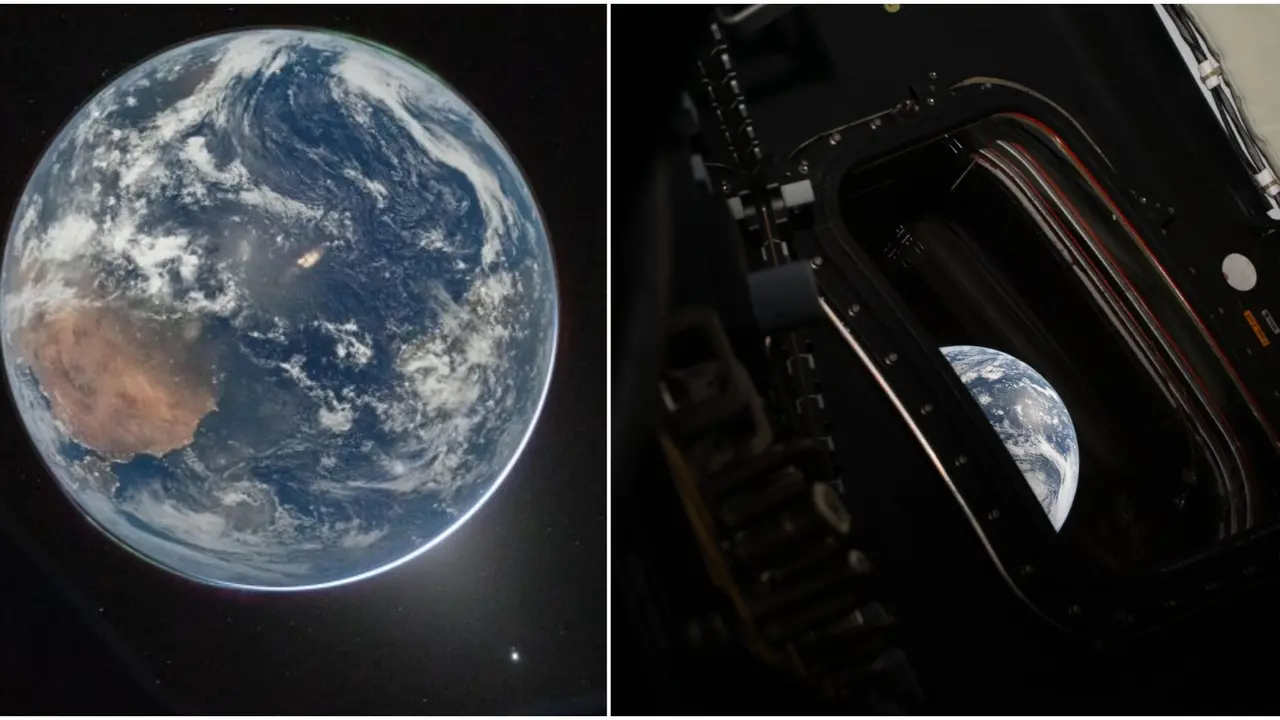
For the first time in over 50 years, humans are traveling beyond Earth’s orbit as NASA’s Artemis II mission unfolds. Launched on April 1, 2026, from Kennedy Space Center, Orion is carrying Commander Reid Wiseman, Pilot Victor Glover, Mission Specialist Christina Koch - now the farthest woman ever to travel from Earth and Canadian astronaut Jeremy Hansen on a 10‑day journey covering nearly 685,000 miles in a lunar fly‑by. Already more than 70,000 miles from Earth, Orion has completed its apogee raise burn and is on a precise trajectory toward its April 6 lunar encounter.
Life aboard Orion is drawing curiosity, with the crew sharing both practical updates and breathtaking views. The spacecraft’s compact waste management system keeps the cabin functional, while Wiseman’s photos reveal Earth eclipsing the Sun, framed by auroras and zodiacal light, and the planet’s terminator line dividing day and night. Together, these glimpses highlight the realities of deep‑space living as humanity prepares to return to the Moon and, eventually, reach Mars.
April 5th 2026, 12:36 IST
Why Artemis II Astronauts Call Their Orion Spacecraft "Integrity"
Artemis II: NASA's Artemis II crew has a special name for their Orion spacecraft: "Integrity", and there's a meaningful story behind it.
The astronauts chose the name for their home away from home because it “embodies the foundation of trust, respect, candor, and humility” values that define the teams working behind the historic Artemis II mission.
For the crew, Integrity isn't just a label; it's a tribute to the dedication and character of everyone who made the journey around the Moon possible.
April 5th 2026, 12:16 IST
NASA Praises Artemis II Crew for Weekend Work Ahead of Monday's Lunar Flyby
Artemis II: NASA has thanked the Artemis II astronauts for working through the weekend as the mission enters its fourth day. The crew continued preparations for Monday's trip around the Moon while also capturing stunning new images from their unique vantage point in deep space.
April 5th 2026, 12:11 IST
Artemis II Crew Captures First Human-Eyed View of Moon's Far Side
Artemis II: NASA has shared a stunning image of the Moon captured by the Artemis II crew during their mission to fly around the lunar surface and photograph its mysterious far side. The image reveals the entire Orientale Basin on the right edge of the lunar disk — a sight never before seen with human eyes.
Sharing the photo on X, NASA wrote, "History in the making. In this new image from our @NASAArtemis II crew, you can see Orientale basin on the right edge of the lunar disk. This mission marks the first time the entire basin has been seen with human eyes."
April 5th 2026, 09:15 IST
Smelly Toilet?
On the downside, their toilet is on the blink again.
The three Americans and one Canadian are set to reach their destination Monday, photographing the mysterious lunar far side as they zoom around. It is the first moon-bound crew in more than 53 years, picking up where NASA's Apollo program left off.
“The Earth is quite small, and the moon is definitely getting bigger,” pilot Victor Glover reported.
April 5th 2026, 06:42 IST
How Far Will Artemis II Travel?
Crew is expected to travel a total of 695,081 miles from launch to splashdown. The spacecraft will pass within 4,066 miles of the lunar surface during its closest approach and will reach a maximum distance of 252,757 miles from Earth, about 4,102 miles farther than Apollo 13.
April 5th 2026, 06:42 IST
How Long is the Artemis II Mission
NASA’s Artemis II mission is an approximately 10-day journey around the Moon including launch, a lunar flyby, and a safe splashdown off the coast of San Diego.
April 5th 2026, 01:32 IST
NASA Astronauts Look Back At Earth En Route Moon
NASA has shared fresh pictures showing astronauts Christina H Koch and Reid Wiseman looking back at Earth from the Orion spacecraft as they continue to move deep into space en route Moon.
Sharing the pictures, NASA wrote, “This view just hits different.”
April 4th 2026, 18:01 IST
Astronauts To Rehearse Zero-Gravity Life-Saving Techniques
Artemis 2 astronauts are set to rehearse zero-gravity life-saving techniques and CPR procedures in space today.
NASA said, "Glover, Koch, and Hansen will demonstrate CPR procedures in space; Wiseman and Glover will check out some of Orion's medical kit, including the thermometer, blood pressure monitor, stethoscope, and otoscope."
April 4th 2026, 07:50 IST
Artemis II Mission Reaches Halfway Point
NASA confirms the Artemis II crew is now about halfway to the Moon aboard Orion. The astronauts are on track for their April 6 lunar fly‑by, where they will conduct scientific observations of the Moon’s surface. This milestone marks a major step in the 10‑day, 685,000‑mile journey bringing humanity closer to its first crewed lunar mission in over 50 years.
April 4th 2026, 07:25 IST
Artemis II: Reid Wiseman’s Stunning Earth View from Orion
Artemis II commander Reid Wiseman has captured a breathtaking image of Earth from the Orion spacecraft, showing our planet glowing against the vast darkness of space. Another photo taken Friday offers a fresh perspective of Earth’s illuminated edge more than 70,000 miles away. These striking visuals, shared by NASA give the world a rare glimpse of our home from humanity’s furthest journey since Apollo.

April 4th 2026, 07:18 IST
Artemis II Video: Watch How The Crew Stays Fit and Fueled in Deep Space
NASA’s latest clip from the Artemis II mission captures the everyday rhythm aboard Orion. Pilot Victor Glover is shown powering through his exercise routine while Canadian astronaut Jeremy Hansen prepares the crew’s midday meal. The video offers a lively glimpse into how astronauts balance fitness and nutrition during their 10‑day, 685,000‑mile journey toward the April 6 lunar fly‑by highlighting the human side of deep‑space exploration.
April 4th 2026, 07:12 IST
Watch: Artemis II Captures Earth’s Glow in the Dark
Even in the shadow of space, our planet shines. In this image taken by the Artemis II crew, the electric lights of human activity sparkle across Earth’s surface, while sunlight gently illuminates the planet’s edge in the lower right. It’s a striking reminder that life on Earth radiates outward, even against the vast darkness of deep space.
April 4th 2026, 07:08 IST
Artemis II Live: Christina Koch Becomes Farthest Woman From Earth as Orion Speeds 70,000+ Miles Toward Lunar Fly‑By
Artemis II LIVE: Artemis II astronaut Christina Koch has set a groundbreaking record, becoming the farthest any woman has ever traveled from Earth. As Orion speeds past 70,000 miles on its way to a lunar fly‑by, Koch’s achievement adds a powerful milestone to the mission, underscoring the expanding role of women in humanity’s return to the Moon and future journeys toward Mars.
April 4th 2026, 07:00 IST
Artemis II Live: NASA's New Video Reveals How Astronauts Manage Waste in Deep Space
Living in microgravity means even basic routines require ingenious solutions. Orion’s universal waste management system is a compact, 5‑cubic‑foot toilet engineered for spaceflight. Solid waste is sealed in odor‑controlled canisters, while pre‑treated urine is vented overboard daily to keep the cabin clean and functional. This new video shared by NASA reveals how the waste management system works on Orion.
Published April 4th 2026, 07:02 IST