Add Republic As Your Trusted Source




Add Republic As Your Trusted Source
Advertisement
Updated December 30th 2025, 22:53 IST
Hubble Spots Twin Jets and Wobble in Rare Interstellar Comet 3I/ATLAS
Astronomers are thrilled by new Hubble images of interstellar comet 3I/ATLAS, revealing two distinct jets of material. Observations from December 2025 show a strong jet toward the Sun and a weaker counter jet, suggesting organized emissions linked to rotation. This rare comet offers insights into material from other stars, posing no threat to Earth during its closest approach.


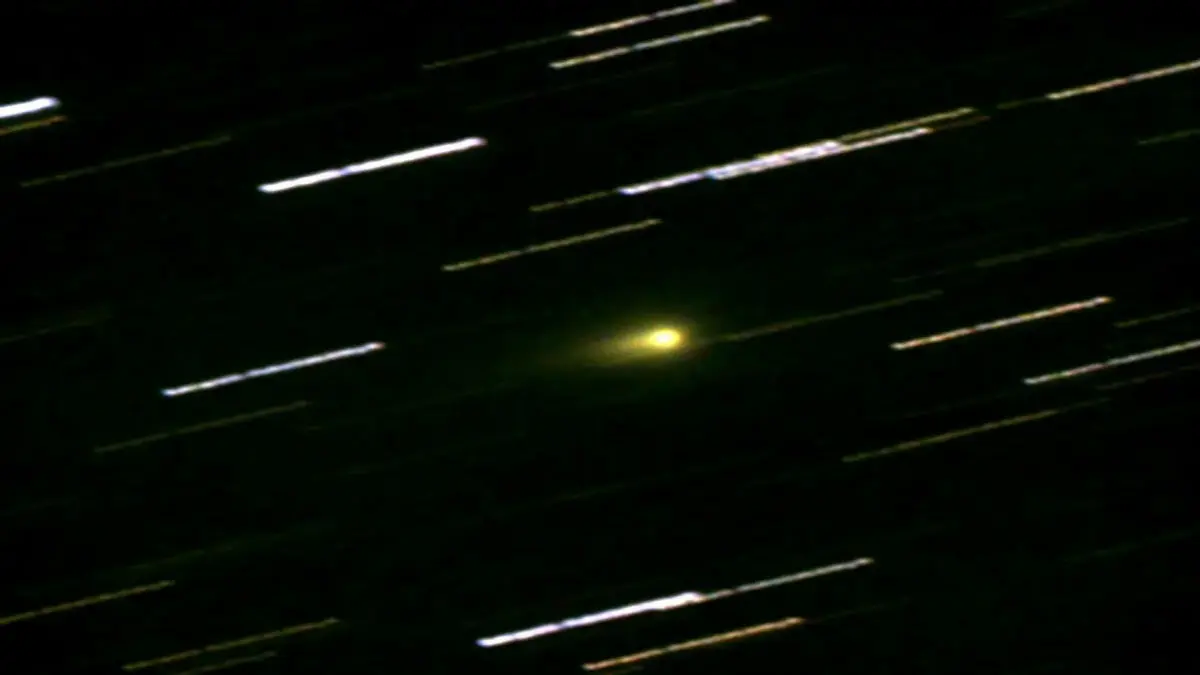
New Delhi: Astronomers are buzzing with excitement after the Hubble Space Telescope captured stunning new images of 3I/ATLAS, a rare interstellar comet passing through our solar system, revealing two distinct jets of material streaming from its surface as it heads back into deep space.
The observations, taken on December 12 and December 27, 2025, show a pair of narrow jets being released from the comet’s nucleus - one strong jet pointing roughly toward the Sun and a weaker counter jet directed away. Scientists say this double-jet structure is unusual and offers new clues into the comet’s internal makeup and rotational dynamics.
A Wobbling Visitor From Beyond
3I/ATLAS is only the third interstellar object ever confirmed to visit our solar system, following ‘Oumuamua and 2I/Borisov. It was first spotted on July 1, 2025, by the Asteroid Terrestrial-impact Last Alert System (ATLAS) in Chile and later confirmed as interstellar due to its hyperbolic trajectory - meaning it entered from outside our solar system and will eventually leave it again.
The twin-jet pattern suggests a highly organised emission process likely tied to the comet’s rotation. According to some scientists, including Harvard physicist Avi Loeb, the jets may originate near a pole of the comet that once faced the Sun before perihelion - the point of closest approach to the Sun on October 29, 2025.
Researchers also note that the jets show a slight wobble, hinting at irregular rotation or uneven activity on the comet’s surface. This wobble could be linked to subtle changes in how sunlight heats different parts of the nucleus, causing material to be ejected in varying directions as the comet spins.
Scientific Payoff From a Fleeting Encounter
As 3I/ATLAS continues to fade from view and journey back into interstellar space, scientists are eager to analyse the full suite of observational data. The comet’s behaviour - particularly its jet structure and rotational dynamics - provides a rare window into the physical properties of material formed around other stars.
Experts stress that while the jets are intriguing, there is no threat to Earth from the comet, which passed closest to our planet on December 19, 2025, at a safe distance of roughly 1.8 astronomical units - much farther than Mars.
Published December 30th 2025, 22:53 IST