Add Republic As Your Trusted Source




Add Republic As Your Trusted Source
Advertisement
Updated November 24th 2025, 18:01 IST
Sky Spectacle! Comet ATLAS breaks up into three brighter parts-Know why this Comet stands out
Comet ATLAS (C/2025 K1) has been traveling through the Ursa Major constellation since November 24 and it's the golden hue which makes this comet (C/2025 K1) unique as compared to the other Comets.


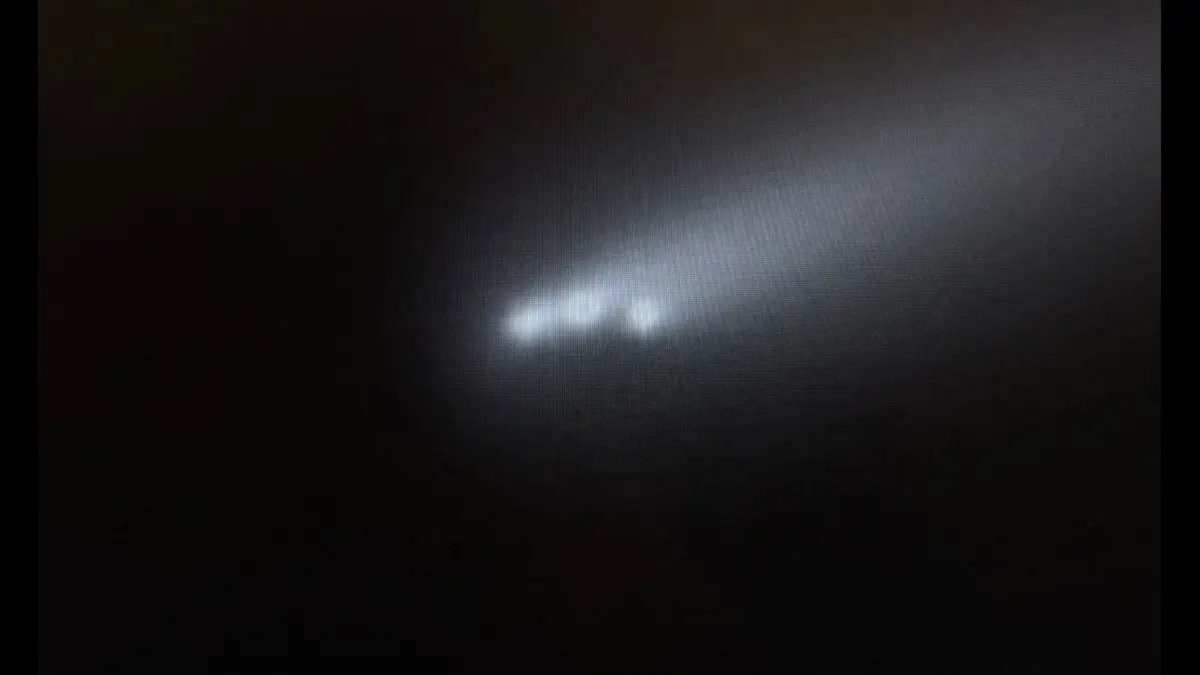
New Delhi: Comet ATLAS (C/2025 K1), which was discovered on May 24, was seen breaking up into at least three brighter fragments dramatically this month. Spaceweather.com, while quoting photographer Michael Jager stated that starting November 12, the celestial body was seen exploding into at least three luminescent parts over the past few weeks. The photographer also prepared an animation which depicts how the spectacle appeared on November 12, 14, 18, 19 and 20.
More about Comet ATLAS (C/2025 K1)
As per SkyLive, Comet ATLAS (C/2025 K1) has been traveling through the Ursa Major constellation since November 24 and it's the golden hue which makes this comet (C/2025 K1) unique as compared to the other Comets. Most Comets appear green and blue owing to the presence of few gases and them being excited by the Sun's ultraviolet radiation. However, the image captured by amateur astronomer Dan Bartlett shoes golden hue. While commenting on the colour, an astronomer at Lowell Observatory in Arizona Dr David Schleicher wrote in his blog post stating the reason behind the golden colour where he said that the Comet ATLAS (C/2025 K1) is probably lacking in carbon-bearing molecules such as di-carbon and cyanide.
Several images of the comet breaking into three pieces has been captured by Italian astronomer Gianluca Masi, and possibly a fourth one, using a robotic unit which is part of the Virtual Telescope Project. As per the spaceweather.com, Comet ATLAS (C/2025 K1) can be easily seen using a normal backyard telescope as it currently has a brightness of magnitude 10, stated a news agency.
Nasa Releases Pictures of interstellar comet older than Solar System
In another news, an interstellar comet 3I/ATLAS, believed to be older than the solar system itself, has been released by NASA. It was in July when 3I/ATLAS was first detected by an ATLAS telescope in Rio Hurtado, Chile. Its unusual, hyperbolic path immediately confirmed that the icy object did not originate here. 3I/ATLAS will make its closest approach to Earth on December 19 at about 170 million miles. Scientists expect more images as the comet moves through the solar system, eventually drifting past Jupiter’s orbit in spring 2026.
Published November 24th 2025, 17:51 IST