Add Republic As Your Trusted Source




Add Republic As Your Trusted Source
Advertisement
Updated December 4th 2025, 17:46 IST
Why Is Europe Rattled With Putin's Visit to India?
With the ongoing Indo-European partnerships, Putin’s visit to India is viewed by Europe as a shadow over Europe’s efforts to solidify these partnerships as India maintains a careful balance between Moscow and the European capitals.


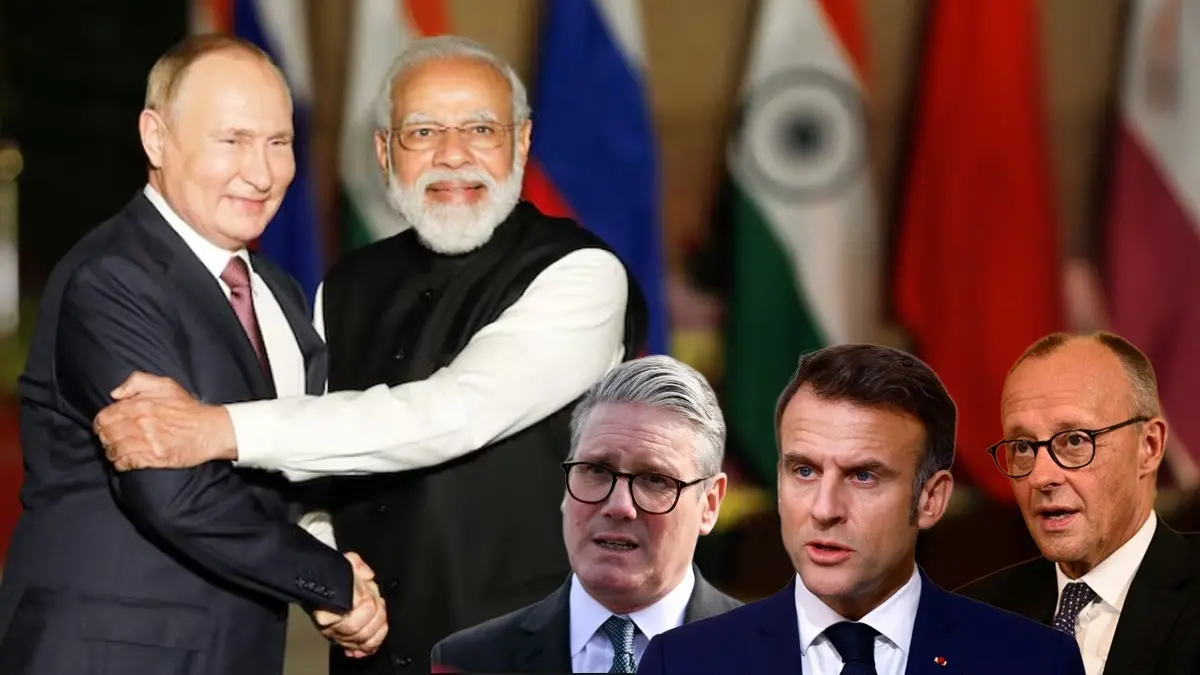
Vladimir Putin’s visit to India on December 4 makes Europe anxious. Envoys of UK, France and Germany attacked Vladimir Putin for escalating the Ukraine war by writing a joint op-ed as India’s deft diplomatic policy maintains a balancing act between Russia and Europe.
As Russian President Vladimir Putin heads to New Delhi for a two day visit on December 4, a diplomatic row has ensued. Envoys from the UK, France, and Germany have written a joint article in a leading national daily blaming Putin for the Ukraine war. The article claimed that Russia is not keen on peace and even suggested war crimes. India's Ministry of External Affairs (MEA) has slammed the article calling it "unacceptable and unusual". Such firm stand from India reaffirms it's foreign policy approach as it balances ties with Russia on defence and energy amid intense global pressures from the West.
It is important to address the core issue as to why Russian President Vladimir Putin’s visit to India has raised an alarm in Europe. Here’s what’s causing the European unease:
Europe’s strategic partnerships with India anticipates competition from Russia
In July 2025, India and the UK signed a landmark Free Trade Agreement (FTA), acknowledged by the UK Prime minister Keir Starmer as one of UK's biggest post Brexit achievements. The deal is projected to boost UK exports to India by nearly 60%, adding an estimated £15.7 billion to the economy by 2040. The FTA not only facilitates business mobility but also collaboration in clean energy, technology, and innovation, signaling a new era of partnership for both nations.
April 2025 saw India and France strike a 63000 crore government-to-government pact for 26 Rafale M fighter jets to bolster the Indian Navy's maritime capabilities. Followed by this is the ongoing discussions between India and France regarding the procurement of another 114 Rafale jets, underscoring the defence alliance.
Germany, too, is pushing hard for a Free Trade Agreement (FTA) with India as part of EU talks, aiming to boost bilateral trade that hit €31 billion in 2024. Berlin has pledged full support to finalize the deal by end of 2025, amid advanced negotiations on goods, services, and investments. Alongside trade, Germany eyes deeper defence ties, including submarines and security pacts. This comes as Europe seeks stronger economic lifelines with New Delhi amid global tensions.
With the ongoing Indo-European partnerships, Putin’s visit to India is viewed by Europe as a shadow over Europe’s efforts to solidify these partnerships as India maintains a careful balance between Moscow and the European capitals.
The Ukraine Conflict’s Wider Impact on Europe
Pokrovsk was once a key logistics center for Ukraine, crucial for moving goods and supplies across the region. However, heavy Russian attacks have left the city devastated and unusable. This damage has cut off an important trade route for Europe, disrupting supply chains and causing serious economic problems. The fall of Pokrovsk is a major setback not just for Ukraine, but also for European trade, illustrating how the conflict’s fallout has direct economic consequences for Europe.
Growing India-Russia Relations Despite the Ukraine War
Indo-Russia trade relations have been gradually increasing now standing at 68.7 billion dollars with import at 63.8 billion dollars and export at 4.9 billion dollars. Russia wants to lessen its dependence on the American dollars undermining the western sanctions, hence India trades in Rupee with Russia through the Special Rupee Vostro Account - SRVA. Hence, Russia now has accumulated a huge chunk of Rupee which it wants to invest in pharmaceuticals, food, apparel, and engineering sectors on the table for discussion on December 4, along with defence and energy sectors.
Emergence of alternate Trade Routes against Western influence
Following the August 2025 summit between Putin and Trump, the Alaska trade corridor has been opened up for Russia, thereby providing an alternative route that competes with Europe’s trade networks. This signals a major shift in regional economic influence challenging Europe’s economic clout in Eurasia.
India’s Independent Foreign Policy Stance
Europe fears the emergence of a possible trifecta of Chine-Russia-India but India continues to act in its own national interest. India refuses to ally exclusively with any side prioritizing its strategic interests above all. The pragmatic diplomacy practiced by India aims to balance its connections with the West, Russia and other nations to secure energy, defence, and technology, making Europe’s diplomatic goals more complex.
Why is Europe concerned?
The apprehension that Europe has regarding Putin’s visit to India stems from Europe’s need to safeguard its growing economic and defence partnerships with India. Putin’s visit is viewed by Europe as a potential threat to its growing economic and defence influence in Asia. In view of the sustained Indo-Russia relationship, Europe is anxious about safeguarding its expanding economic and defence partnerships with India, highlighting how India has become a global player in the world stage with having to navigate through the power rivalries in order to protect its own strategic autonomy by maintain a diplomatic balancing act amid escalating East-West tensions.
(Written by Tanushree Chakraborty)
Published December 4th 2025, 17:46 IST